What You're Really Paying For: A Real-World Breakdown of Waterjet Price
Let’s talk about the waterjet price. If you’re reading this, you’ve probably seen numbers that make your head spin—anywhere from the cost of a decent car to a small house. In my thirty years of running a fabrication business and consulting for others, I’ve learned one hard truth: the sticker price is just the beginning. The real conversation about waterjet price isn’t about finding the cheapest machine. It’s about understanding the value behind every dollar you spend, and more importantly, what you don’t spend later.
A low initial quote can be the most expensive mistake you’ll ever make. Let’s cut through the sales brochures and look at what actually builds the cost of a waterjet system, from the pump to the long-term service, and why a brand like VICHOR often represents a smarter financial decision over a ten-year horizon.
How the Machine Works: The Engineering You Pay For
First, you’re not buying a magic box. You’re investing in a sophisticated piece of industrial machinery designed to create and control immense force. A standard pump takes water and pressurizes it to 60,000, 90,000, or even over 100,000 PSI.
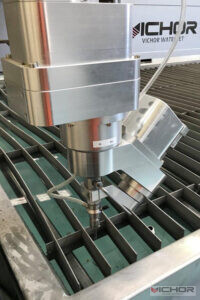
This ultra-high-pressure water is focused through a tiny gemstone orifice, creating a supersonic stream. For cutting metal, stone, or glass, abrasive garnet is injected into this stream. The water accelerates the abrasive, which does the actual cutting through pure erosion.
The entire system—the pump, the rigid frame to handle the cutting forces, the precision motion system, and the CNC brain—is engineered to manage this process reliably. The quality of this engineering is the single biggest factor in the waterjet price and your future profitability.
Application Dictates Specification (and Cost)
Your intended use is the primary driver of cost. A shop cutting intricate 1/4″ aluminum parts has fundamentally different needs than a plant slicing 4″ thick steel plate all day, every day.
The waterjet price for a machine meant for light prototyping or artistic work on stone will be lower. It might have a smaller table, a lower horsepower pump, and a simpler control system.
An industrial system for heavy plate cutting requires a high-horsepower pump (e.g., 75HP or more), a massive, stress-relieved steel table to resist vibration, and premium motion components. This spec commands a much higher price, but it’s the only tool that will survive in that environment.
The Two Main Types: A Cost Division
This is a fundamental fork in the road. Pure waterjet systems (water only, no abrasive) are used for cutting soft materials like rubber, foam, food, and gaskets. They are generally less expensive because they don’t require an abrasive delivery system or the same level of cutting head complexity.
Abrasive waterjet systems are the universal cutters. They handle metal, stone, composites, and ceramics. They are more complex, have more wear parts, and consequently, have a higher baseline waterjet price. Over 90% of industrial inquiries are for this type.
The 5 Core Components That Build the Price
When you get a quote, it’s the sum of these parts. Skimping on any one can be catastrophic.
1. The High-Pressure Pump: This is the engine, often 30-50% of the system cost. Horsepower and maximum pressure rating are key. A 50HP pump from a quality manufacturer like VICHOR is a different beast—and investment—than a 30HP generic unit. Reliability here is non-negotiable.
2. The Cutting Table & Structure: Size matters (a 5’x10′ table costs more than a 4’x4′), but construction matters more. A lightweight, bolted-together frame is cheap. A heavy, welded, and machined frame that maintains precision under load costs real money. This is the foundation of your cut quality.
3. The Motion System & CNC: Are you getting basic stepper motors or high-performance servo drives? Is the control software intuitive and powerful, or clunky and limited? Can it do advanced taper compensation? The difference in waterjet price here is the difference between a productive asset and a constant frustration.
4. Brand & Component Provenance: An off-brand machine assembled with generic parts will have a tempting low price. A machine from an established engineering brand uses proven, durable components and invests in R&D. You pay for that peace of mind and lower lifetime failure rates.
5. Automation & Add-Ons: An automatic abrasive delivery system, a height sensor, a 5-axis cutting head, or material handling robots all add significant cost. But they also add massive productivity, which can justify the higher initial waterjet price.
The Hidden Cost: Total Cost of Ownership (TCO)
This is where savvy buyers separate from the rest. The purchase price is just the entry fee. You must calculate TCO over 5-10 years.
Operating Costs: Abrasive garnet is your largest ongoing consumable. Pump efficiency affects your electricity bill. Wear parts (orifices, mixing tubes, seals) are regular expenses.
Maintenance & Downtime: How easy is it to service? How available and expensive are spare parts? A machine that’s down for a week waiting for a $5,000 proprietary part has a devastating real cost.
Cut Quality & Secondary Labor: A cheap machine may produce tapered, rough edges that require hours of grinding. A precise machine from VICHOR produces parts that are often weld-ready, saving thousands in labor.
A higher-quality machine often has a higher purchase price but a dramatically lower TCO.
Service: Your Insurance Policy
Never buy a waterjet based on waterjet price alone without considering the service behind it. The pump will need maintenance. Things will wear out. When they do, you need a partner, not just a supplier.
Does the company have local or responsive technical support? Can you get genuine parts quickly? Do they offer training and preventative maintenance plans? The service network of a company like VICHOR is a core part of the product’s value, protecting your investment from catastrophic downtime.
Finding Your Solution: Aligning Price with Need
The goal isn’t to buy the most expensive or the cheapest machine. It’s to buy the right machine. An honest supplier will act as a consultant.
They should ask about your material mix, thickness, required precision, and production volume. They might tell you that you don’t need the ultra-high-pressure option, saving you money. Or they might insist that you need a heavier table for your work, preventing a future regret.
The right waterjet price is the one that gets you a machine configured to be a profit center for your specific business, backed by support that ensures it stays that way for a decade or more.
Investing in a waterjet is a major decision. By looking past the initial waterjet price and focusing on the engineering, the total cost of ownership, and the service partnership, you make a decision based on value, not just cost. This approach leads to a machine that becomes the backbone of your shop’s capabilities, not a piece of equipment that drains your budget and patience.
Frequently Asked Questions (FAQs)
Q1: What is the realistic starting price for a new, production-ready abrasive waterjet?
A1: For a new, industrial-grade abrasive waterjet with a 4’x4′ or 4’x6′ table and a reliable 30-50HP pump from a known manufacturer, you should budget between $120,000 and $200,000. “Entry-level” machines below this often compromise critically on pump durability, table rigidity, or software, costing you more in the long run.
Q2: Is buying a used waterjet a good way to save on the waterjet price?
A2: It can be, but it’s high-risk. You must thoroughly inspect pump hours (like car mileage), check for frame alignment, and test the CNC. The biggest risk is being orphaned—if the original manufacturer no longer supports that model, finding parts can be impossible. A used machine from a current, supportive brand like VICHOR with a known service history is a much safer bet.
Q3: How much does it cost to run a waterjet per hour?
A3: Excluding labor and depreciation, the main variable costs are abrasive garnet and electricity. For a mid-sized pump cutting 1/2″ steel, abrasive might cost $15-$30 per hour, and electricity $3-$8 per hour. Wear parts (orifice, mixing tube) add another few dollars per hour averaged over their lifespan. Poor machine efficiency can significantly increase these numbers.
Q4: Why is there such a huge range in waterjet price quotes?
A4: It almost always comes down to the quality of the five core components listed above. One quote might be for a machine with a generic pump, a light-duty frame, and basic software. Another, higher quote is for a machine with a premium pump, a massively rigid table, precision servos, and advanced controls. They are fundamentally different tools.
Q5: Do companies offer financing, and does it make sense?
A5: Reputable manufacturers and their dealers almost always offer financing or leasing options. For many businesses, this is an excellent strategy. It preserves capital, and the monthly payment can often be covered by the revenue generated from the machine. Leasing can also provide tax advantages and make it easier to upgrade technology later. Always factor the cost of financing into your total waterjet price analysis.