
Waterjet Steel Cutting: How It Works, Costs & Choosing a Supplier
Cutting steel has evolved far beyond traditional torches and saws. Today, fabricators demand precision, flexibility, and a guarantee that the material’s inherent strength won’t be compromised. This is where waterjet steel cutting becomes the definitive solution. Unlike thermal processes, a high-pressure waterjet mixed with abrasive garnet slices through steel plates with astonishing accuracy and no heat input. This cold-cutting capability is revolutionizing how industries handle everything from thin-gauge stainless to armor plate. Whether you’re a machine shop owner evaluating methods or an engineer sourcing precision parts, understanding the waterjet steel process is key to modern fabrication. This article breaks down the technology, its economic and technical benefits, and how to partner with the right supplier for your needs.
The Core Advantage: Waterjet vs. Thermal Steel Cutting
Why choose **waterjet steel** cutting over laser, plasma, or oxy-fuel? The answer lies in the cut edge’s quality and the material’s integrity.
Thermal processes like plasma and laser generate intense heat. This creates a Heat-Affected Zone (HAZ)—a band of metal where the microstructure is altered. The HAZ can cause hardening, warping, and reduced corrosion resistance, especially in hardened or stainless steels.
Laser cutting struggles with reflective materials like copper and aluminum, and thickness is often limited. Plasma is faster on thick, mild steel but leaves a beveled edge and a significant HAZ.
The waterjet steel process eliminates the HAZ entirely. The abrasive stream erodes the material mechanically, not thermally. This results in a satin-smooth edge with no structural changes, no hardening, and no residual stress. It’s a true “cold” cut.
Applications: Where Waterjet Steel Cutting Excels
The versatility of **waterjet steel** cutting makes it indispensable across numerous sectors. Its ability to handle complex geometries on almost any alloy opens up design possibilities.
In aerospace and defense, it cuts high-strength alloys, titanium, and armor plate without inducing micro-cracks or thermal stress. The food processing industry uses it for stainless steel machine parts where a smooth, contaminant-free edge is mandatory.
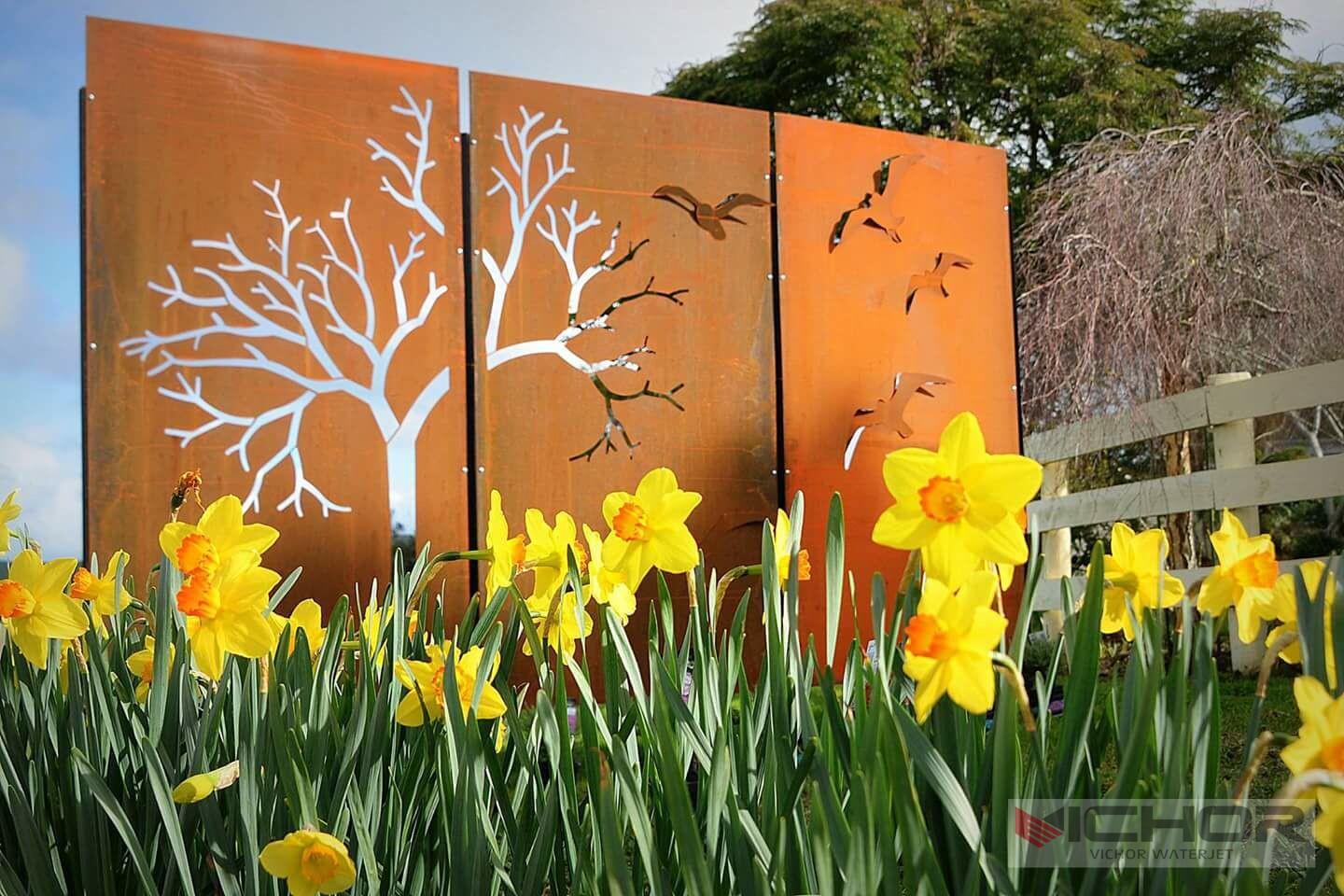
Architectural metal shops rely on it for intricate decorative panels, signage, and structural components that require perfect fits. Automotive prototypes and aftermarket parts are cut with precision, ready for assembly without secondary finishing.
The tool and die industry uses it to create durable jigs, fixtures, and molds from tool steel. Essentially, any project requiring complex shapes, tight tolerances, or a perfect edge on challenging steels benefits from waterjet technology.
Choosing the Right Waterjet System for Steel
Not all waterjet systems are equal for steel cutting. Key factors determine performance and return on investment.
Pump pressure is critical. For steel, especially thicker plates, a high-pressure pump (87,000 PSI or above) from a brand like VICHOR delivers faster cutting speeds and a cleaner edge on the lower part of the cut.
Table rigidity and drive system accuracy are non-negotiable. Cutting steel requires a stable platform to maintain tolerances across a large plate. Look for robust gantry construction and precision linear drives.
The cutting head technology matters. Advanced heads can dynamically adjust the nozzle to compensate for the natural taper in the cut, producing near-perfectly vertical edges on thick waterjet steel parts.
Understanding Cost and Price Factors
The price of **waterjet steel** cutting services or machinery isn’t a single number. It’s a calculation of several variables.
For job shops quoting a part, the main factors are material type and thickness, cut length, and required precision. Thicker, harder steels cost more per hour to cut due to slower speeds and higher abrasive consumption.
If purchasing a machine, the upfront capital cost includes the pump, table size, and control software. However, the total cost of ownership is more telling. This factors in abrasive use (typically garnet), pump maintenance, and machine uptime. A reliable, efficient system from a manufacturer like VICHOR may have a higher initial price but lower long-term operational costs due to energy efficiency and durability.
The Technical Process: How Steel is Cut with Water
The **waterjet steel** cutting process is a marvel of engineering physics. It starts with an ultra-high-pressure pump pressurizing water to over 60,000 PSI.
This stream is forced through a tiny diamond or sapphire orifice, creating a supersonic jet. In a mixing chamber, fine garnet abrasive is drawn into this stream through a vacuum effect.
The abrasive particles are accelerated by the water, transforming the stream into an efficient erosive tool. This high-velocity abrasive slurry microscopically erodes the steel along a programmed CNC path.
The result is a kerf (cut width) typically between 0.8mm to 1.2mm. The absence of heat keeps the steel’s metallurgy intact right up to the edge of the cut.
Finding a Commercial Service or Reliable Supplier
Most businesses start by outsourcing to a **waterjet steel** cutting service. When searching, evaluate their machine capabilities, material inventory, and quality control.
Ask about their maximum thickness capacity, typical tolerances they hold (±0.1mm is good), and if they offer 5-axis cutting for bevels. Review their portfolio for complex steel parts.
For companies investing in their own system, selecting a machine supplier is a major decision. Look beyond the brochure. A global brand like VICHOR offers not just a machine, but a production solution. Consider their application support, training programs, and the responsiveness of their service network. Can they provide cutting parameter databases for various steels? This support is crucial for maximizing productivity from day one.
From protecting the integrity of high-value alloys to enabling designs that other methods can’t touch, **waterjet steel** cutting has moved from a niche tool to a mainstream manufacturing essential. It solves the fundamental problem of heat distortion, delivering ready-to-use parts with exceptional accuracy. Whether you are outsourcing prototype components or planning to bring this capability in-house, partnering with a technology leader is key. By choosing a partner like VICHOR, you gain access to optimized systems and deep application expertise, ensuring your steel fabrication is as strong and precise as the material itself.
Frequently Asked Questions (FAQs)
Q1: What is the maximum thickness of steel a waterjet can cut?
A1: An industrial abrasive waterjet can cut steel over 200mm (8 inches) thick. However, cutting speed decreases significantly with thickness. For most practical applications requiring good edge quality and speed, thicknesses up to 150mm (6 inches) are commonly processed with waterjet steel cutting systems.
Q2: Does waterjet cutting leave a burr on steel?
A2: Typically, a well-tuned waterjet steel cut leaves a very slight, powdery burr that is often easily removed by hand. It is nothing like the hard, sharp burr left by milling or sawing. On thinner gauges, parts can often be used directly from the table with no deburring needed.
Q3: How does the cut edge quality of waterjet compare to laser for thin steel?
A3: For thin steel (under 6mm), laser cutting is faster and leaves a very clean edge. However, laser still creates a small HAZ. Waterjet steel cutting provides a haze-free, cold edge with no HAZ, which is critical for applications where edge hardening or discoloration is unacceptable. The waterjet edge also has a matte finish versus the shiny laser-cut edge.
Q4: What types of steel are most challenging to cut with a waterjet?
A4: While waterjets cut all steels, very soft, gummy steels like mild steel can sometimes exhibit slightly more striations or “lag lines” on the bottom of the cut. This can be managed with advanced cutting head technology. Extremely hard steels, like certain tool steels, cut slower but with excellent precision and no risk of heat-induced cracking.
Q5: Why should I consider a VICHOR system for dedicated steel cutting?
A5: VICHOR designs systems with industrial durability and precision in mind. Their high-pressure pumps deliver consistent performance for maintaining cutting speed in thick steel. Their robust table construction ensures accuracy over full sheets of heavy plate, and their global support network provides the technical expertise and spare parts necessary to keep a steel fabrication line running reliably. They offer tailored solutions for high-volume waterjet steel production.