
Waterjet Rubber Cutting: Precision Fabrication for Gaskets and Seals
Fabricating parts from soft, elastomeric materials presents unique challenges in manufacturing. Traditional methods like die cutting or manual trimming often struggle with flexibility and material deformation. Waterjet rubber cutting has established itself as the superior solution for processing these complex materials.
This technology utilizes a high-velocity stream of pure water to slice through rubber without creating heat or mechanical stress. Unlike thermal cutting methods, the waterjet process ensures that the chemical composition of the rubber remains unaltered. This is critical for maintaining the elasticity and durability of seals and gaskets.
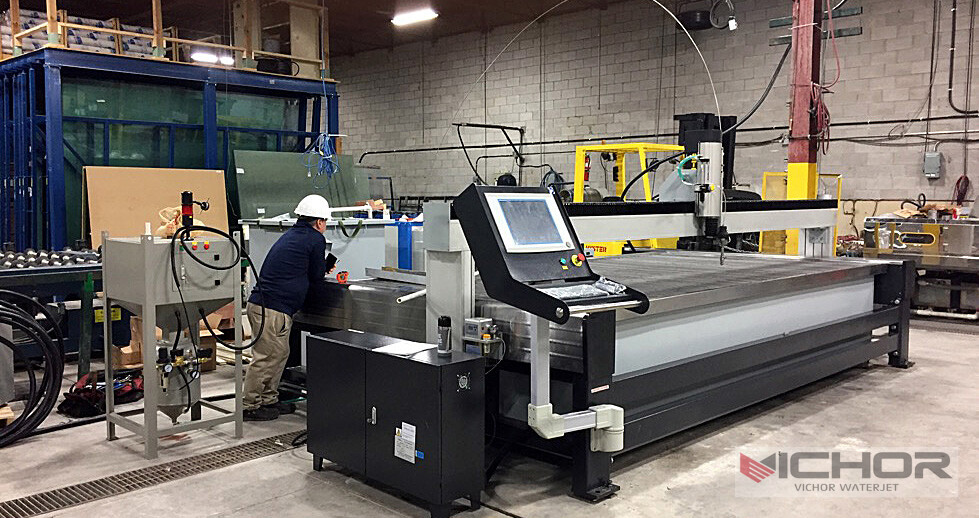
Manufacturers worldwide rely on advanced machinery from brands like VICHOR to execute these precise cuts. Whether for rapid prototyping or mass production, understanding the nuances of this cold-cutting technology is essential for modern industry.
The Mechanics of Cutting Rubber with Water
The fundamental operation of a waterjet system involves pressurizing water to extreme levels, often exceeding 60,000 PSI. This pressurized water is forced through a jewel orifice, creating a coherent stream thinner than a human hair.
For most rubber applications, the process utilizes “Pure Waterjet” technology. This means no abrasive garnet is added to the stream. The sheer force and velocity of the water are sufficient to erode soft materials cleanly.
Key operational features include:
- High Velocity: The stream travels at speeds up to Mach 3.
- Narrow Kerf: The cutting width is incredibly small, typically around 0.004 to 0.007 inches.
- Cold Cutting: No heat is generated, preventing melting or scorching of the rubber.
This method prevents the “concave” edge effect often seen when die-cutting thick rubber. The water stream cuts vertically, maintaining excellent perpendicularity even on thicker stock.
Advantages Over Traditional Die Cutting
Historically, die cutting was the standard for rubber gaskets. However, waterjet rubber processing offers distinct advantages that address the limitations of physical dies.
Elimination of Tooling Costs
Die cutting requires the fabrication of a physical steel rule die. This incurs upfront costs and delays production. Waterjet systems are CNC-controlled, meaning they cut directly from a digital drawing (DXF or DWG file). There is no hard tooling required.
Rapid Prototyping and Design Changes
In product development, designs change frequently. With a waterjet, modifying a gasket shape is as simple as updating the drawing file. This flexibility allows engineers to test multiple iterations in a single day without waiting for new dies.
Superior Edge Quality
Physical blades can compress rubber as they cut, leading to an hourglass profile on the edge. Waterjets cut without this compression, resulting in a square edge that seals better in critical applications.
Types of Rubber Materials Suitable for Waterjet
Waterjet technology is compatible with a vast spectrum of elastomers. The machine settings can be adjusted to accommodate different Shore hardness levels and material densities.
Neoprene and EPDM
These are the workhorses of the gasket industry. Neoprene offers resistance to oils and chemicals, while EPDM is excellent for outdoor weathering. Both cut cleanly with pure waterjet streams, leaving smooth edges ready for assembly.
Silicone Rubber
Silicone is known for its high-temperature resistance and flexibility. It is often soft and difficult to hold during mechanical cutting. The non-contact nature of the waterjet stream makes it ideal for processing delicate silicone sheets.
Viton and High-Performance Elastomers
Viton is expensive and used in harsh chemical environments. The precision of waterjet rubber cutting minimizes material waste. Tighter nesting (placing parts close together) ensures you get the maximum number of parts from these costly sheets.
Reinforced Rubber
Some rubber sheets contain cloth or metal wire insertion for strength. While pure water cuts most rubber, reinforced variants might require a light abrasive mixture to cut through the metal mesh without delaminating the layers.
Industrial Applications and Solutions
The versatility of this cutting method allows it to serve various sectors. VICHOR machines are frequently deployed in industries requiring strict adherence to tolerances and material purity.
Automotive Manufacturing
Cars require hundreds of seals, from engine gaskets to door weather stripping. Waterjets are used to produce prototypes for new models and limited-run parts for classic car restorations where original dies no longer exist.
HVAC and Plumbing
Custom flanges and pipe seals are essential for HVAC systems. Waterjet cutting allows for the on-demand creation of gaskets in non-standard sizes, reducing the need for massive inventory storage.
Aerospace and Defense
Aerospace components demand materials that can withstand extreme pressure and temperature. The cold-cutting process ensures that the molecular structure of the aerospace-grade rubber is not compromised during fabrication.
Production Efficiency: Stacking and Nesting
One of the primary ways to increase throughput in waterjet rubber production is through “stacking.” Because the water stream remains coherent over a distance, operators can stack multiple thin sheets of rubber on top of each other.
Benefits of stacking include:
- Increased Output: Cutting 5 sheets at once increases production speed by 500%.
- Uniformity: All parts in the stack have identical dimensions.
- Cost Reduction: Reduced machine time translates to lower cost per part.
Nesting software further enhances efficiency. Algorithms analyze the shape of the parts and arrange them on the sheet to minimize scrap. For expensive materials like Viton, this optimization is a significant cost saver.
Pricing Factors and Cost Analysis
Understanding the cost structure of waterjet services helps in budgeting and project planning. Unlike injection molding, costs are driven by time and complexity rather than tooling.
Material Thickness and Hardness
Thicker rubber requires a slower cutting speed to maintain a vertical edge and prevent “lag” (where the bottom of the cut trails the top). Denser rubber varieties also slow down the cutting head, increasing the cost per inch.
Geometry Complexity
Straight lines are fast and cheap to cut. Intricate geometries with sharp corners require the machine to decelerate to maintain accuracy. A complex gasket with many bolt holes will cost more than a simple square pad.
Quantity and Setup
While there is no tooling cost, there is a setup cost for loading material and programming. Ordering in larger batches spreads this setup cost across more parts, lowering the unit price.
Choosing the Right Equipment: The VICHOR Advantage
For businesses looking to bring cutting capabilities in-house, selecting the right machine is pivotal. VICHOR offers waterjet solutions specifically calibrated for precision and durability.
Their systems feature:
- Robust Pump Technology: delivering consistent pressure for smooth cuts.
- User-Friendly Software: simplifying the import of CAD files.
- Precision Motion Control: ensuring strict tolerances are met.
Investing in reliable equipment minimizes downtime and ensures consistent quality. Support and availability of spare parts are also critical factors that established manufacturers provide.
Technical Challenges and How to Overcome Them
While highly effective, processing rubber with water does come with specific nuances. Experienced operators know how to mitigate potential issues to ensure a perfect result.
Managing Taper
All waterjet cuts have a slight natural taper. On thin rubber, this is negligible. On thick rubber (over 1 inch), it becomes visible. Using a 5-axis cutting head or dynamic tilt compensation can eliminate this taper by angling the nozzle.
Material Bounce
Rubber is flexible. If not secured properly, the force of the water can cause the material to vibrate or lift. Operators use weights, clamps, or a vacuum assist table to hold the rubber sheet firmly against the slats.
Blowout on Soft Foam
Very soft foam rubber can “blow out” on the bottom side due to turbulence. Using a brick or sacrificial material underneath the rubber provides support and results in a clean exit for the water stream.
Environmental Impact and Sustainability
Modern manufacturing is increasingly focused on sustainability. Waterjet rubber cutting is an inherently green process. It uses only water and electricity.
Unlike laser cutting, which can burn rubber and release toxic fumes (especially from Chlorine-based rubbers like Neoprene), waterjet cutting produces no hazardous vapors. This creates a safer working environment for operators and eliminates the need for expensive fume extraction systems.
Furthermore, the water used in the process can often be recycled through a closed-loop system, reducing overall water consumption. The waste generated is simply small particles of rubber which can be filtered out.
Preparing Your Design for Waterjet Cutting
To ensure the best results, designers should follow specific guidelines when preparing files for rubber cutting. The file format is usually a 2D vector file.
Design tips include:
- Scale: Always draw at a 1:1 scale.
- Lines: Ensure all geometry consists of closed loops.
- Common Lines: In some cases, parts can share a cut line to save time, but this requires specific software pathing.
- Tolerance Awareness: Remember that rubber is flexible; extremely tight tolerances (+/- 0.001″) are hard to measure on soft parts.
Comparison with Laser Cutting
Laser cutting is another popular method for sheet materials, but it has severe limitations with rubber. Lasers cut by burning, which creates a charred edge on rubber parts. This carbon residue can rub off and contaminate sensitive assemblies.
Additionally, the heat from the laser can change the material properties near the edge, making it brittle. Waterjet cutting involves no thermal transfer, ensuring the edge remains as elastic as the center of the part. For thick rubber, lasers often struggle to maintain focus, whereas waterjets cut through substantial thickness with ease.
Future Trends in Rubber Fabrication
The industry is moving toward greater automation and integration. Robotic waterjet cells are becoming more common for cutting 3D rubber parts, such as molded dashboards or complex automotive interiors.
Advancements in high-pressure pumps are also allowing for faster cutting speeds. Higher pressure translates to a more coherent stream, which cuts faster and leaves a smoother finish. As materials science evolves, new synthetic rubbers are being developed, and waterjet technology adapts alongside them.
For the fabrication of gaskets, seals, and custom elastomeric parts, waterjet rubber cutting offers an unmatched combination of speed, quality, and versatility. It eliminates the constraints of tooling, avoids thermal damage, and handles a wide range of material thicknesses.
Whether you are a small job shop or a large-scale manufacturer, leveraging technology from leaders like VICHOR ensures production efficiency. As the demand for precision custom parts grows, the role of waterjet technology in rubber processing will only continue to expand.
Frequently Asked Questions (FAQ)
Q1: Can waterjet cutting handle thick rubber blocks?
A1: Yes, waterjet machines can easily cut rubber blocks up to 4 inches thick or more. However, as thickness increases, the cutting speed must be reduced to maintain a straight, vertical edge and prevent significant tapering at the bottom of the cut.
Q2: Does the rubber get wet, and does this affect the material?
A2: Yes, the process is wet. However, most industrial rubbers like Neoprene, EPDM, and Silicone are water-resistant and do not absorb moisture. The parts are typically air-dried or wiped down immediately after cutting, with no negative impact on the material’s performance.
Q3: What is the minimum hole size that can be cut in rubber?
A3: The waterjet stream is approximately 0.005 to 0.007 inches in diameter for pure water applications. Therefore, holes as small as 0.010 inches can be cut, although practical limitations usually suggest a minimum hole diameter of around 0.030 inches for stability.
Q4: Is it possible to cut rubber with adhesive backing?
A4: Absolutely. Waterjets excel at cutting rubber with pressure-sensitive adhesive (PSA) backings. The water stream cuts through the rubber, the adhesive, and the release liner cleanly without gumming up the tool, which is a common issue with mechanical blades.
Q5: How does waterjet cutting compare to die cutting for large production runs?
A5: For extremely large runs (tens of thousands of parts), die cutting is generally faster and cheaper per unit once the die is paid for. However, waterjet is superior for low to medium volumes, prototypes, and thick materials where dies would distort the part.