
Waterjet Cutting Thickness: Essential Factors, Material Limits, and Process Optimization
When precision cutting meets heavy-duty industrial demands, waterjet cutting thickness becomes the defining metric for capability and efficiency. Manufacturers, fabricators, and engineering teams rely on waterjet technology to slice through materials ranging from soft rubber to hardened steel. Understanding the variables that influence maximum cut depth ensures consistent quality, reduced operating costs, and expanded application scope. This guide explores the core parameters, material behaviors, and advanced strategies that shape waterjet cutting thickness performance.
What Determines Waterjet Cutting Thickness Capabilities?
The maximum thickness a waterjet can cut is not a fixed number—it fluctuates based on machine specifications, material properties, and operational settings. Unlike laser or plasma cutting, waterjets use high-pressure water combined with abrasive garnet to erode material without heat distortion. This erosion process allows for greater thickness potential but introduces complexity in parameter selection.
Key determinants include:
- Pump pressure – Higher pressure (up to 90,000 psi or more) increases kinetic energy, enabling deeper cuts.
- Abrasive type and flow rate – Garnet mesh size and feed consistency directly affect erosion speed.
- Nozzle orifice and focusing tube – Precision components that concentrate the jet stream.
- Material hardness and density – Softer materials allow greater thickness; hardened alloys reduce feasible depth.
- Cutting speed and traverse rate – Slower speeds improve penetration but impact productivity.
Pump Pressure and Intensifier Technology
Ultrahigh-pressure pumps create the driving force behind every cut. For thick-section work, direct-drive or intensifier pumps must maintain stable pressure throughout the cutting cycle. A drop of 5,000 psi can reduce effective depth by nearly 20% in dense metals. Modern systems from established manufacturers like VICHOR integrate closed-loop pressure control to sustain consistent waterjet cutting thickness results.
Abrasive vs. Pure Water Cutting
Pure water cutting handles soft materials like foam, rubber, and plastics up to moderate thickness. When thickness exceeds 1 inch in metals or dense composites, abrasive waterjet becomes mandatory. The abrasive accelerates material removal, allowing cuts through steel plates exceeding 6 inches and titanium up to 4 inches under optimal conditions.
Abrasive parameters to monitor:
- Garnet mesh size: 80 mesh for faster removal on thick sections, 120 mesh for finer edge quality.
- Abrasive flow rate: typically 0.5 to 1.5 lb/min, adjusted based on thickness.
- Mixing tube length and diameter: influence jet coherence and kerf width.
Material-Specific Thickness Boundaries in Waterjet Cutting
Every material responds differently to the cutting stream. Industry benchmarks help operators estimate feasible waterjet cutting thickness before programming.
Below are typical maximum thicknesses achievable with high-performance abrasive waterjet systems (80,000 psi, optimized abrasive feed):
- Mild steel: up to 8 inches (203 mm) – production rates decrease beyond 6 inches.
- Stainless steel (304/316): up to 6 inches (152 mm) – taper becomes more pronounced.
- Aluminum (6061): up to 10 inches (254 mm) – excellent erosion properties.
- Titanium alloys: up to 5 inches (127 mm) – requires slower speeds.
- Hardened tool steel: 3 to 4 inches (76–102 mm) – heat-affected zone avoided.
- Granite & stone: up to 12 inches (305 mm) – common in architectural cutting.
- Glass & ceramics: up to 3 inches (76 mm) – careful pressure regulation prevents shattering.
- Composites (carbon fiber): up to 2.5 inches (63 mm) – delamination risk if feed rates are aggressive.
These values assume high-quality abrasives and well-maintained equipment. Actual achievable thickness also depends on part geometry, corner radii, and tolerance requirements.
Technological Factors That Extend Cutting Depth
Beyond basic parameters, advanced machine features directly expand the range of waterjet cutting thickness. Investing in precision components reduces downtime and improves consistency across thick sections.
Dynamic Waterjet and Taper Control
When cutting thick materials, jet lag and taper become critical issues. Dynamic waterjet systems automatically tilt the cutting head to compensate for stream deflection. This technology maintains perpendicular walls even in 6-inch steel plates, ensuring dimensional accuracy.
Benefits for thick-section work:
- Eliminates secondary machining (reaming, grinding).
- Reduces material waste by minimizing kerf angle variance.
- Enables stacked cutting of multiple sheets.
Multi-Pass Cutting Strategy
For extreme thickness beyond a machine’s single-pass capacity, multi-pass cutting offers a solution. The jet makes successive passes, each removing additional material. While slower, this method can achieve clean cuts in materials up to 12 inches thick using standard abrasive waterjet systems.
Multi-pass parameters to consider:
- Offset distance between passes: 0.5–1.0 mm to avoid excessive kerf widening.
- Pressure and abrasive flow remain consistent across passes.
- Programmed dwell times at corners to ensure complete penetration.
Optimizing Performance for Demanding Thickness Applications
Achieving reliable results at the upper limits of waterjet cutting thickness requires systematic optimization. Operators and process engineers should focus on the following areas.
Fine-Tuning Abrasive Delivery
Inconsistent abrasive flow is a primary cause of premature cutting stoppage in thick materials. Use closed-loop abrasive metering systems to maintain uniform feed. Regularly inspect the mixing tube for wear; a worn tube diffuses the jet and reduces effective depth by 15–30%.
Cutting Speed Versus Edge Quality
Thick-section cutting demands slower traverse speeds. However, excessively slow speeds cause kerf widening and may increase abrasive consumption unnecessarily. A balanced approach uses speed calculators that consider material hardness and target surface finish (Ra values). Start with manufacturer-recommended speed tables and perform test cuts to calibrate for specific material batches.
Nozzle Selection and Maintenance
The focusing tube (nozzle) diameter influences jet coherence. For thick cuts, a larger diameter (1.02 mm to 1.2 mm) allows higher abrasive flow but reduces precision. Replace nozzles when wear exceeds 0.1 mm increase in diameter to maintain cutting efficiency.
How Machine Quality Directly Impacts Thickness Capability
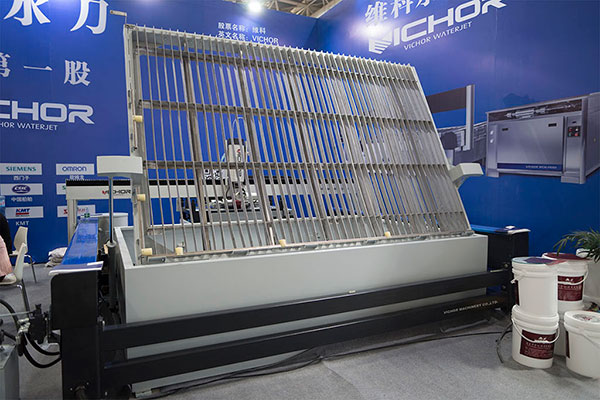
The structural rigidity of a waterjet table, the precision of motion control, and the reliability of the pump system all dictate whether a machine can repeatedly handle maximum thickness. VICHOR engineering focuses on heavy-duty gantry designs, industrial-grade linear guides, and high-cycle intensifier pumps to ensure consistent performance across demanding thickness ranges.
Features that enhance thickness capacity:
- Reinforced steel frames that resist deflection under high-pressure cutting forces.
- High-accuracy ball screws or rack-and-pinion drives with closed-loop feedback.
- Advanced CNC software with thickness-specific parameter libraries.
- Modular abrasive systems that support extended unattended cutting for thick plates.
Conclusion: Mastering Waterjet Cutting Thickness for Industrial Success
From automotive components to aerospace structural parts, the ability to predict and control waterjet cutting thickness separates routine cutting from advanced manufacturing excellence. By understanding the interplay of pump pressure, abrasive dynamics, material properties, and machine rigidity, shops can push boundaries while maintaining tight tolerances. Continuous investment in technology—such as dynamic taper compensation, precision abrasive delivery, and robust machine frames—ensures that thickness limits continue to expand. Partnering with experienced equipment providers like VICHOR delivers the support and engineering needed to tackle the most challenging thickness requirements.
Frequently Asked Questions About Waterjet Cutting Thickness
Q1: What is the maximum thickness a waterjet can cut in steel?
A1: With a high-performance abrasive waterjet system (up to 90,000 psi), mild steel can be cut up to 8 inches (203 mm) in thickness. For stainless steel, practical maximum is approximately 6 inches (152 mm) under optimized conditions. Production rates and edge quality decline beyond these thresholds, though multi-pass strategies can extend depth further.
Q2: Does waterjet cutting thickness depend more on pump pressure or abrasive quality?
A2: Both factors are critical, but they interact. Pump pressure provides the kinetic energy, while abrasive quality and flow determine the erosion rate. For thick materials, high pressure (80,000+ psi) combined with consistent garnet feed produces the best results. A pressure drop of 10,000 psi can reduce cutting depth by 30% even if abrasive is ideal.
Q3: Can waterjet cut materials thicker than 12 inches?
A3: In specialized applications with multi-pass cutting, some operators have achieved clean cuts in materials up to 12–14 inches thick, particularly in softer materials like aluminum or foam. However, for most industrial settings, 8 inches in metal and 12 inches in stone represent the practical upper limit for single-pass production cutting.
Q4: How does material hardness affect waterjet cutting thickness limits?
A4: Harder materials (e.g., hardened tool steel, Inconel, tungsten) significantly reduce achievable thickness. While a waterjet can cut soft aluminum up to 10 inches, hardened steel above 45 HRC may be limited to 3–4 inches. The jet erodes material through micro-fracturing; harder surfaces resist fracture, requiring slower speeds and higher abrasive consumption.
Q5: What maintenance steps help maintain maximum waterjet cutting thickness over time?
A5: Regular replacement of the mixing tube (nozzle) every 80–150 cutting hours, inspection of the orifice for wear, and cleaning of the abrasive hopper and feed lines prevent thickness degradation. Also, verifying pump pressure calibration and maintaining water quality (filtering to <1 micron) ensures consistent jet coherence for deep cuts.
Q6: Can waterjet cutting thickness be increased by slowing down the cut speed drastically?
A6: To a point, yes. Reducing traverse speed allows the jet more time to erode material, increasing maximum thickness. However, excessive slowdown causes kerf widening, increased taper, and higher abrasive costs. An optimal speed balances thickness, edge quality, and operating economy. Dynamic waterjet systems help maintain accuracy even at reduced speeds.
Q7: Is it possible to cut stacked plates to improve productivity for thick parts?
A7: Stack cutting is viable if the total stack thickness stays within the machine’s effective range. For example, cutting three 2-inch steel plates stacked yields a total thickness of 6 inches—similar to cutting a single 6-inch plate. Ensure proper clamping and that all layers are securely bonded to prevent jet deflection between sheets.
Explore advanced waterjet solutions: VICHOR waterjet cutting machines are engineered for superior thickness capability, precision, and industrial reliability.