
Metal Water Jet Cutting: 5 Key Comparisons, Applications, and Cost Factors for 2025
When your project involves cutting metal, the term metal water jet comes up often. It’s not just another tool; it’s a fundamentally different approach to fabrication. Unlike heat-based methods, it uses a high-pressure stream of water mixed with abrasive garnet to erode the material.
This cold-cutting process is revolutionizing how shops handle everything from thin aluminum sheets to thick titanium blocks. If you’re weighing options for metal fabrication, understanding where a metal water jet cutter excels is crucial.
Metal Water Jet vs. Laser, Plasma, and EDM: A Real-World Comparison
Choosing the right tool means knowing the trade-offs. Here’s how metal waterjet cutting stacks up.
Against Laser Cutting: Lasers are faster and more precise for thin sheet metal (under 1/2 inch). However, lasers create a Heat-Affected Zone (HAZ) that can harden or warp metal. A water jet for metal produces no HAZ. It also cuts reflective metals (copper, brass) and thick plate that lasers cannot handle.
Against Plasma Cutting: Plasma is fast and cost-effective for thick, non-precision steel plate. Its downside is a wide kerf, significant HAZ, and lower precision. For parts requiring accurate dimensions or ready-to-weld edges, metal water jet cutting is superior.
Against Wire EDM: EDM is extremely precise but very slow and typically for conductive materials only. Water jet cutting of metal is much faster for through-cutting and works on any metal, conductive or not.
The verdict? A metal water jet is the versatile all-rounder, especially for mixed materials, thick sections, and when thermal distortion is unacceptable.
Top Applications in Modern Metal Fabrication
So, where is metal water jet technology actually used? Its applications are broad and growing.
Aerospace & Defense: Cutting high-strength alloys like titanium, Inconel, and aluminum composites without compromising their structural integrity is paramount. No heat means no micro-crack initiation.
Machine Shops & Tooling: Producing precision gears, fixtures, jigs, and prototypes from tool steel, stainless, and brass. The ability to cut hardened metals is a key advantage.
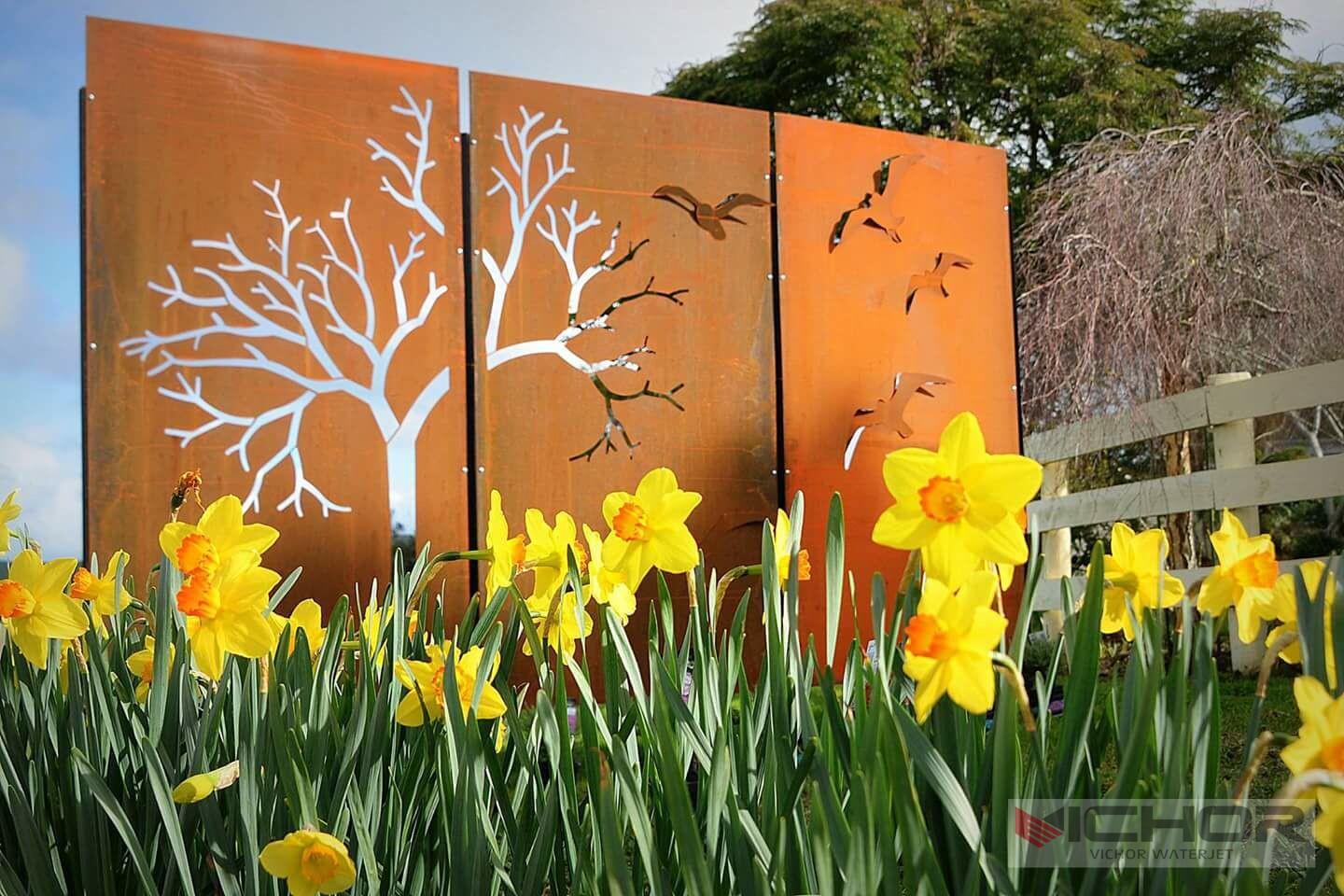
Architectural Metalwork: Creating intricate decorative panels, signage, and structural elements from stainless steel, bronze, and Corten steel. Design complexity is virtually unlimited.
Marine & Transportation: Cutting thick aluminum plate for hull components and flame-resistant materials for interior panels. The cold cut ensures material properties remain intact.
General Fabrication: For job shops that see a wide variety of materials and part geometries, a metal water jet machine acts as a single, go-to solution.
How to Choose the Right Metal Water Jet System
Not all systems are equal for metalwork. Here’s a selection guide focused on metal fabrication needs.
Pump Power (HP): This dictates your cutting speed in thick metal. For cutting 2-inch aluminum or 1-inch steel at a production pace, a 60HP to 100HP pump is standard. More power means faster cutting in heavy plate.
Table Size and Construction: Ensure the work envelope fits your largest common plate size. The table must be robust to handle the weight and vibration of dense metal sheets.
Cutting Head Technology: For precision metal parts, look for Dynamic Head Control (DHC) to maintain a consistent standoff. For welding preparations, a 5-axis waterjet head is necessary to cut clean, ready-to-weld bevels.
Software Capability: The software must offer robust kerf compensation for different metals and thicknesses. Advanced nesting features are critical to minimize waste on expensive metal stock.
Understanding Cost: Purchase Price and Operational Economics
The cost of a metal water jet system has two main components: capital and operational.
A new industrial-grade system focused on metal cutting can range from approximately $150,000 for a basic setup to over $500,000 for a large-format, automated cell.
Operational costs are where your per-part cost is determined. Abrasive garnet is your largest consumable expense—thicker, harder metals use more. Pump maintenance (seals, valves) is a scheduled cost. Electricity and water filtration round out the ongoing expenses.
For shops not ready to invest, contract metal waterjet services from a provider like VICHOR offer a pay-per-part model with no capital outlay.
The Technical Edge: Why It Works for Any Metal
The science behind metal waterjet cutting is what makes it universally applicable. The stream’s kinetic energy, transferred through the abrasive particles, erodes the metal at a microscopic level.
Because it’s a mechanical erosion process, not a thermal one, it doesn’t matter if the metal is heat-sensitive, reflective, or hardened. It will cut through 10-inch thick aluminum, 6-inch steel, or delicate heat-treated tooling plate with equal effectiveness.
The key technical parameters for metal are pressure (ideally above 60,000 PSI), abrasive flow rate, and precise speed control. Optimizing these for each metal type yields the best edge quality and speed.
Finding a Reliable Service Provider or Equipment Supplier
If you’re looking to outsource, your choice of a metal water jet service defines your part quality. Look for a provider with a track record in industrial metal fabrication, not just sign-making.
Ask about their experience with your specific metal type and thickness. Inquire about their quality control measures and inspection capabilities. Providers like VICHOR specialize in high-tolerance metal cutting for demanding sectors, offering not just cutting but often finishing and value-added services.
If you’re buying, look beyond the brand name. Evaluate the local service support, parts availability, and training. A company like VICHOR competes by offering robust performance and strong technical support, often at a different value point than the largest brands.
VICHOR’s Focus on High-Performance Metal Cutting
At VICHOR, our systems are engineered with metal water jet fabrication as a primary focus. We understand the demands of cutting tough alloys day in and day out.
Our pumps are built for sustained high pressure, which is essential for efficient thick-metal cutting. Our motion systems provide the rigidity and accuracy needed for tight-tolerance metal parts.
We emphasize solutions that reduce the total cost of metal cutting: efficient abrasive delivery, reliable components to minimize downtime, and software tools that optimize material yield on expensive metal sheets. For fabricators who live and breathe metal, we provide a machine that’s a dependable partner on the shop floor.
Frequently Asked Questions (FAQ)
Q1: What is the maximum thickness you can cut with a metal water jet?
A1: It depends on the metal and machine power. A robust industrial metal water jet can cut over 8 inches (200mm) of aluminum and up to 6 inches (150mm) of mild steel with acceptable quality. For very hard metals like tool steel, the practical limit is typically around 4-5 inches. Speed decreases significantly as thickness increases.
Q2: Does water jet cutting leave a ready-to-weld edge on metal?
A2: Yes, one of its best features. The water jet cut metal edge is clean, oxide-free, and has a slight texture that can be ideal for welding. There is no hardened Heat-Affected Zone to interfere. For beveled weld preparations, a 5-axis waterjet head can cut a precise, ready-to-weld bevel in a single pass.
Q3: How precise is metal water jet cutting?
A3: Modern systems are highly precise. You can routinely hold tolerances of ±0.003″ to ±0.005″ (±0.08mm to 0.13mm) on critical dimensions. The kerf (cut width) is consistent, allowing for accurate compensation in your CAD files. For most fabrication work, this is more than sufficient.
Q4: Is it cost-effective for thin sheet metal compared to a laser?
A4: For high-volume production of thin gauge (under 1/4″) carbon steel, a laser is generally faster and has a lower operating cost per part. However, for mixed-material shops, low-volume jobs, or when cutting reflective or heat-sensitive metals (stainless, aluminum, copper), the metal water jet becomes the more cost-effective and versatile choice overall.
Q5: How do you prevent rust on cut steel parts?
A5: This is a common concern. The process itself does not cause rust. However, if bare steel sits with the water slurry, surface rust can form quickly. Best practice is to promptly remove parts from the table, rinse them with clean water if necessary, and apply a rust inhibitor or dry them immediately. Many shops have a standard procedure to address this.