Water Jet Milling Machine: Precision Material Removal Without Thermal Stress
Machining complex contours or pockets in metals, composites, and advanced alloys often requires methods that avoid heat-related distortion. The water jet milling machine has emerged as a viable alternative to conventional milling for specific applications. Instead of a rotating cutter, this technology uses a high-velocity abrasive-laden stream to erode material layer by layer. Engineers and job shops are increasingly turning to the water jet milling machine when they need to remove stock from sensitive materials, create shallow pockets, or machine near-net-shape parts without inducing residual stresses.
How a Water Jet Milling Machine Differs from Traditional Milling
Conventional milling relies on mechanical contact between a rotating cutter and the workpiece. This generates friction, heat, and cutting forces that can distort thin-walled components or alter material properties.
A water jet milling machine replaces the solid tool with a focused stream of water and abrasive. The process is non-contact, meaning no tool wear in the traditional sense and no mechanical stress on the workpiece.
Because there is no heat-affected zone (HAZ), materials that are sensitive to thermal input—such as titanium, Inconel, and carbon fiber composites—retain their original mechanical properties after milling operations.
Key Applications of Water Jet Milling
The milling variant of waterjet technology is suited for selective material removal, surface preparation, and intricate pocketing. Common uses include:
Aerospace Component Machining
Titanium and nickel-alloy parts often require material removal for weight reduction or fitment. A water jet milling machine can create shallow channels and contours without inducing micro-cracks or metallurgical changes.
Composite Panel Trimming and Pocketing
Carbon fiber laminates are prone to delamination when machined with conventional cutters. The cold stream eliminates this risk, allowing clean removal of plies for fastener pockets or edge profiling.
Tool and Die Surface Preparation
For mold surfaces or die components, controlled water jet milling can remove scale or prepare surfaces for coating without altering base material hardness.
Additive Manufacturing Support Removal
3D-printed metal parts often have support structures that need removal. Water jet milling provides a gentle yet precise method to eliminate these without affecting the printed geometry.
Core Components of a Modern Water Jet Milling Machine
While similar to standard waterjet cutting systems, machines optimized for milling incorporate specific features to achieve precise material removal rates and depth control.
- High-pressure pump: Typically 60,000 to 90,000 psi to ensure adequate kinetic energy for erosion.
- Precision CNC control: 5-axis capability allows the nozzle to follow complex contours while maintaining consistent standoff distance.
- Abrasive delivery with flow modulation: Fine control over garnet flow rate enables varying material removal depths.
- Z-axis height sensing: Automatic gap control maintains optimal distance between nozzle and workpiece for uniform erosion.
- Software for layer mapping: CAM programs calculate toolpaths for removing specific volumes rather than just cutting profiles.
Leading manufacturers like VICHOR integrate these elements into robust systems, ensuring that the water jet milling machine delivers repeatable results across production runs.
Material Compatibility and Depth Control
One of the primary considerations when using a water jet milling machine is the material’s erosion rate. Softer materials remove faster, while harder alloys require slower traverse speeds or multiple passes.
Metals
Aluminum, brass, and mild steel can be milled efficiently with controlled depths up to several millimeters per pass. Stainless steel and titanium typically need multiple passes to achieve precise pocket depths without compromising surface finish.
Composites
Carbon fiber, fiberglass, and laminates respond well to water jet milling because the process does not generate heat that could separate layers. Depth accuracy is maintained by programming constant pressure and abrasive flow.
Exotics (Inconel, Hastelloy)
High-temperature alloys are challenging for conventional milling due to work hardening. A water jet milling machine circumvents this, but slower feed rates and higher abrasive consumption are expected.
Operators can achieve depth tolerances within ±0.002 inches by fine-tuning pressure, abrasive flow, and toolpath overlap. This precision makes the water jet milling machine suitable for applications requiring both material removal and dimensional accuracy.
Advantages Over Conventional Milling
Switching to water jet milling offers several operational and quality-related benefits, particularly for sensitive or complex parts.
- No thermal distortion: Ideal for thin-walled structures and heat-treated materials.
- No tool wear: Eliminates frequent cutter changes and associated setup time.
- Reduced fixturing: Lower cutting forces mean simpler workholding, often using vacuum tables.
- Multi-material capability: Same machine can mill, cut, and drill without tool changes.
- Burr-free finish: Eliminates deburring operations required after traditional milling.
These advantages translate into shorter lead times and lower overall processing costs for many applications. Shops that add a water jet milling machine often expand their service offerings to include jobs previously outsourced or avoided due to technical challenges.
Process Considerations and Best Practices
To maximize the effectiveness of water jet milling, operators should adopt specific strategies that differ from standard cutting operations.
Toolpath Strategy
Milling toolpaths use overlapping passes similar to conventional pocketing. Stepover distances between passes affect surface finish and depth uniformity. Typical stepover ranges from 30% to 70% of the jet’s effective diameter.
Abrasive Flow Adjustment
For shallow material removal (0.010–0.050 inches), lower abrasive flow rates provide better control. Deeper milling requires higher flow to maintain erosion rates without slowing traverse speeds excessively.
Multiple Passes vs. Single Deep Pass
Instead of a single deep pass, multiple passes with slight depth increments produce smoother surfaces and more consistent results. This approach also reduces the risk of unintended over-cutting.
Standoff Distance
Keeping the nozzle close to the workpiece (typically 0.040–0.080 inches) improves accuracy and prevents the jet from flaring. Automated height sensing is highly recommended for complex geometries.
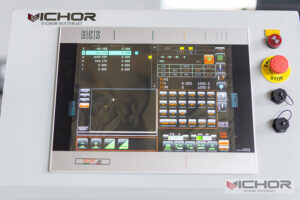
VICHOR’s control software simplifies these adjustments, allowing operators to quickly configure the water jet milling machine for specific materials and depth requirements.
Integrating Water Jet Milling into a Production Workflow
Many manufacturers combine water jet milling with conventional machining to leverage the strengths of both technologies. For instance, a part might be rough-milled with water jet to remove stock quickly without heat, then finished with a traditional CNC mill for tight tolerances.
Water jet milling also serves as a preparatory step for welding or bonding. By removing coatings or surface layers without affecting the base material, joint quality improves.
With VICHOR systems, users can switch between cutting and milling modes seamlessly, maximizing machine utilization across different job types.
Expanding Capabilities with Water Jet Milling Technology
The water jet milling machine represents a valuable addition to any precision manufacturing environment. It fills the gap between conventional milling and waterjet cutting, offering controlled material removal without the drawbacks of thermal or mechanical stress. From aerospace components to composite structures, this technology enables fabricators to take on challenging projects with confidence.
Choosing a reliable system from an experienced provider like VICHOR ensures access to robust hardware, intuitive software, and the support needed to implement effective milling processes. As industries continue to demand higher precision and cleaner processing methods, the role of water jet milling will only expand.
Frequently Asked Questions
Q1: What is the difference between a water jet cutting machine and a water jet milling machine?
A1: A standard water jet cutting machine is designed for through-cutting profiles, while a water jet milling machine focuses on controlled material removal to create pockets, contours, or surface features without cutting entirely through the workpiece. Milling applications require precise depth control, overlapping toolpaths, and often 5-axis capabilities.
Q2: What materials can be processed with a water jet milling machine?
A2: Virtually any material that can be cut by abrasive waterjet can also be milled. This includes metals (steel, aluminum, titanium, Inconel), composites (carbon fiber, fiberglass), ceramics, stone, and even some plastics. The key requirement is that the material erodes predictably under the abrasive stream.
Q3: What kind of depth accuracy can I expect from water jet milling?
A3: With proper machine calibration and optimized parameters, depth tolerances of ±0.002 inches (0.05 mm) are achievable. Factors influencing accuracy include material hardness, abrasive flow consistency, and standoff distance control. Automated height sensing greatly improves repeatability.
Q4: Is water jet milling faster than conventional CNC milling?
A4: It depends on the application. For rough material removal on large surfaces or heat-sensitive materials, water jet milling can be faster because it eliminates the need for coolant management and tool changes. For high-precision finishing of small features, conventional milling may still offer speed advantages. Many shops use both methods complementarily.
Q5: Does water jet milling produce a smooth surface finish?
A5: Surface finish depends on stepover distance, abrasive mesh size, and the number of passes. Using finer abrasive (120 mesh) and reducing stepover yields smoother finishes, comparable to conventional milling. For final surfaces requiring very low roughness, a light finishing pass or secondary operation may still be needed.
Q6: Does VICHOR offer water jet milling machines with full 5-axis capability?
A6: Yes, VICHOR provides waterjet systems equipped with advanced 5-axis cutting heads and precision CNC controls tailored for milling applications. These machines feature automatic height sensing, programmable nozzle tilt, and CAM software that supports pocketing, contouring, and variable-depth material removal. Their engineering team assists customers in configuring the right solution for their specific milling needs.
“`