Water Jet Cutting Porcelain Tile: Precision, No Chips, Complex Shapes
Why Choose Water Jet Cutting Porcelain Tile?
water jet cutting porcelain tile offers distinct advantages over mechanical scoring or laser methods. The waterjet’s narrow stream cuts intricate curves and internal holes effortlessly. There is no heat, so the tile’s glaze and structure remain intact.
No Chipping or Cracking
Porcelain is brittle. A water jet exerts only point pressure, unlike a saw blade that vibrates. Edges come out smooth and ready for installation. This reduces waste and rework significantly.
Complex Shapes and Inlays
From custom medallions to geometric floor patterns, water jet technology handles any design. The CNC follows vector files precisely, allowing repeats with micron accuracy. water jet cutting porcelain tile makes artistic expressions possible.
Fast and Accurate Production
Modern waterjets cut at speeds up to 500 mm/min depending on tile thickness. Multiple tiles can be stacked to boost throughput. VICHOR’s machines feature intuitive nesting software to maximize material usage.
How Water Jet Cutting Porcelain Tile Works
The process begins with a high‑pressure pump, typically 60,000 to 90,000 psi. Water is forced through a tiny diamond orifice, creating a supersonic stream. For porcelain, abrasive garnet is added to erode the material.
Abrasive vs. Pure Water Cutting
Porcelain is harder than glass, so abrasive is essential. The garnet particles accelerate in the water stream and wear away the tile. Pure water jets are used for softer materials like rubber or foam.
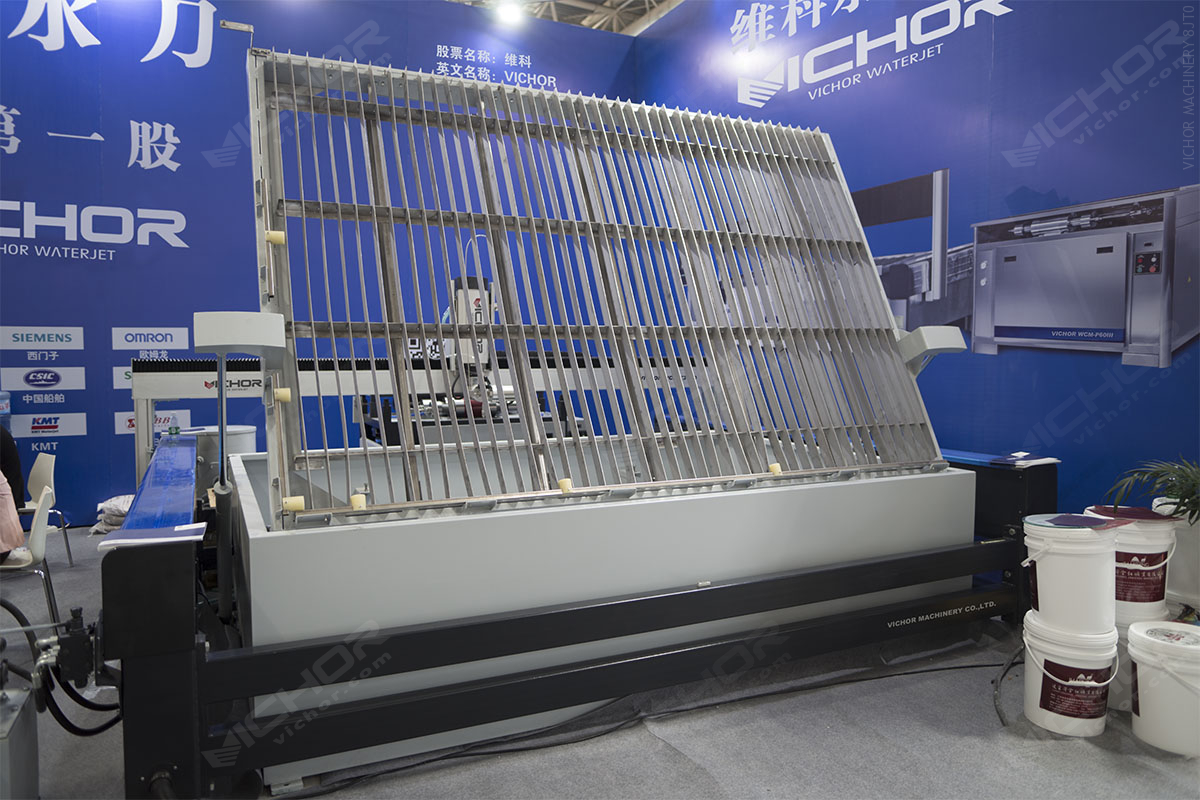
Key Machine Components
- High‑pressure pump (direct‑drive or intensifier).
- Cutting head with mixing chamber and focusing tube.
- CNC gantry system with servo motors.
- Catch tank with water and abrasive removal.
VICHOR integrates these components into robust frames that resist vibration, ensuring clean cuts every time.
Advantages Over Traditional Porcelain Tile Cutting Methods
Comparing water jet cutting porcelain tile with conventional techniques shows clear benefits.
- Manual snap cutter: limited to straight lines, risk of uneven break.
- Angle grinder: produces dust, noise, and often chips glaze.
- Bridge saw: requires blade changes, cannot cut internal shapes.
- Laser: cannot cut non‑metallics effectively; may cause thermal cracks.
- Waterjet: one tool for any shape, no tool wear, cold process.
Fabricators who switch to waterjet report fewer rejects and the ability to take on custom work that competitors cannot.
Applications of Water Jet Cutting Porcelain Tile
water jet cutting porcelain tile is used across residential, commercial, and industrial projects.
Custom Floor Medallions
Intricate circular or oval designs with contrasting colors are cut precisely and assembled like puzzle pieces. Hotels and showrooms often feature these as focal points.
Wall Mosaics and Murals
Artists scan drawings and convert them to cutting files. Waterjet reproduces every detail in porcelain, creating durable artwork for lobbies and facades.
Industrial Tiling
Factories and laboratories require chemical‑resistant floors. Porcelain tiles cut to exact dimensions fit around machinery and drains without gaps.
Thin Porcelain Slabs
Large‑format porcelain panels (up to 5 mm thick) are used for countertops and cladding. Waterjet cuts them without breakage, even with delicate edges.
Factors Affecting Cut Quality and Speed
Several variables influence the outcome of water jet cutting porcelain tile.
- Tile thickness: thicker tiles require slower speeds and more abrasive.
- Abrasive quality: clean, sharp garnet cuts faster and leaves smoother edges.
- Pressure stability: consistent pressure prevents striation marks.
- Nozzle condition: worn focusing tubes widen the stream, reducing precision.
- Feed rate: too fast causes rough edges; too slow wastes time.
VICHOR’s control software automatically adjusts parameters based on material data, taking the guesswork out of setup.
Maintenance Tips for Porcelain Tile Cutting
Proper care keeps your waterjet performing optimally for years.
- Inspect the mixing tube daily; replace when the bore diameter increases by 0.1 mm.
- Clean the water tank regularly to prevent abrasive buildup.
- Monitor water quality; use soft water to avoid scaling in the pump.
- Check high‑pressure seals for leaks each shift.
- Lubricate linear guides and ball screws weekly.
VICHOR provides maintenance schedules and remote diagnostic support with every machine.
Why VICHOR Machines Excel at Porcelain Tile Cutting
VICHOR designs waterjet cutting machines specifically for hard materials like porcelain. Their frames are stress‑relieved and precision‑ground to maintain alignment. High‑pressure pumps from VICHOR deliver consistent flow, and the intuitive CNC makes programming simple. Customers report that water jet cutting porcelain tile on a VICHOR machine reduces waste by up to 30% compared to saw cutting.
Visit VICHOR’s product page to see models equipped with features ideal for tile fabrication: large tables, multi‑head options, and advanced nesting.
To summarize, water jet cutting porcelain tile is the preferred method for achieving flawless edges and complex designs. It outperforms traditional tools in speed, accuracy, and versatility. With a VICHOR waterjet, your shop can handle high‑end residential projects, commercial installations, and artistic commissions with confidence. Contact VICHOR today to discuss your tile cutting needs and receive a customized quote.
Frequently Asked Questions (FAQ)
Q1: Can water jet cutting porcelain tile handle very thin tiles?
A1: Yes, waterjet cuts thin porcelain (3–6 mm) easily without breakage. The gentle stream pressure is adjustable to prevent lifting or cracking. VICHOR machines include parameter presets for thin materials.
Q2: What is the minimum radius possible with water jet cutting porcelain tile?
A2: The minimum radius depends on the focusing tube diameter. With a 0.8 mm nozzle, inside corners can be as tight as 0.5 mm. For most decorative work, this allows sharp angles and fine details.
Q3: Does water jet cutting porcelain tile damage the glaze?
A3: No, the cold water stream does not alter the glaze. Edges remain smooth, and there is no heat‑induced discoloration or crazing. This is a major advantage over laser or plasma.
Q4: How much does a water jet machine for porcelain tile cost?
A4: Entry‑level systems start around $50,000, while industrial models with large tables exceed $200,000. VICHOR offers machines across this range, and they can provide financing options.
Q5: Can I cut stacked porcelain tiles to save time?
A5: Yes, waterjet can cut multiple stacked tiles if they are firmly clamped. This increases productivity for repetitive shapes. VICHOR’s machines accommodate stacks up to 100 mm high, depending on pump power.
Q6: What kind of abrasive is best for porcelain tile?
A6: Garnet mesh size #80 or #120 is commonly used. It provides a good balance between cut speed and edge finish. VICHOR recommends high‑quality Australian garnet for consistent results.