
The Real Cost of a Water Jet Cutting Machine: 2025 Price Guide & 5 Factors That Matter
Searching for the “cost of a water jet cutting machine” can be confusing. You’ll see figures ranging from $70,000 to over $500,000. That’s a massive spread. The reason is simple: a waterjet isn’t a single product. It’s a configurable system where every choice impacts the final waterjet machine price.
Let’s be honest. You’re not just buying a machine; you’re making a capital investment. Understanding what drives the cost of a waterjet cutter is the first step to making a smart decision. This guide breaks down the numbers, explains the “why” behind them, and helps you budget for both the sticker price and the long-term operational costs.
We’ll also look at how manufacturers like VICHOR create value across different price points, ensuring you get a reliable return on your investment.
How It Works: The Tech Behind the Price Tag
To grasp the cost of a water jet cutting machine, you need to know what’s inside. The core technology is fascinating. A high-pressure pump (intensifier or direct-drive) pressurizes ordinary water to an extreme level, often above 60,000 PSI.
This ultra-high-pressure water is then forced through a tiny jewel orifice. The result is a supersonic stream of water.
For cutting metals, stone, or composites, this stream isn’t enough. An abrasive material, usually garnet sand, is introduced into the water jet inside a mixing tube. This creates a potent, erosive cutting tool.
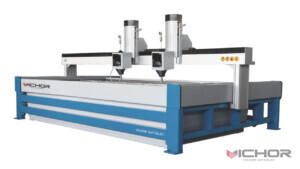
A computer-controlled (CNC) gantry system moves this cutting head with high precision over the workpiece. The complexity and quality of these three core systems—the pump, the cutting head, and the CNC motion platform—are what primarily determine the waterjet cutting equipment cost.
5 Key Factors That Determine Your Final Cost
When you receive a quote for a water jet cutting machine, it’s the sum of these major components. Ignoring any one can lead to budget surprises later.
1. The High-Pressure Pump: This is the engine and the single largest cost driver. A robust 60HP or 87HP intensifier pump from a reputable maker forms a significant part of the industrial waterjet cutter price. Direct-drive pumps cost less upfront but may have lower maximum pressure and different long-term service needs.
2. Cutting Table Size and Structure: A small 2’x4′ table for prototyping is one thing. A massive 10’x20′ table for full steel plates is another. The cost of a waterjet cutting machine scales directly with table size and rigidity. Heavy, vibration-damped construction is essential for accuracy but adds to the price.
3. The CNC Control System: This is the brain. A basic controller handles simple jobs. An advanced PC-based system with intuitive software for nesting, kerf compensation, and 3D beveling adds to the CNC waterjet machine cost. Good software saves material and time, offering a quick return on investment.
4. Cutting Head Technology: A standard 2-axis head is standard. For cutting complex tapered edges, a 5-axis head is needed. This advanced functionality significantly increases the waterjet machine price but is essential for aerospace or precision welding prep.
5. Options and Automation: Add-ons like automatic abrasive hoppers, water chillers, closed-loop water recycling systems, and drill-to-start units each add to the final cost of a water jet cutting machine. These improve efficiency and shop cleanliness but are reflected in the quote.
Price Ranges: From Entry-Level to Production Powerhouse
So, what can you actually expect to pay? Here’s a realistic 2024 breakdown.
Entry-Level / Small Format Machines ($70,000 – $150,000): This tier often includes smaller table sizes (e.g., 2’x2′ to 4’x4′) and lower horsepower pumps (30HP-50HP). It’s suitable for workshops, R&D labs, or businesses cutting primarily softer materials like foam, rubber, or thin plastics. The waterjet machine price here gets you in the door.
Mid-Range / Standard Industrial Models ($150,000 – $350,000): This is the sweet spot for most job shops and fabricators. Expect a robust intensifier pump (60HP-100HP), a durable 4’x8′ or 5’x10′ cutting table, and a capable CNC system. This range covers the typical cost of a waterjet cutter for serious production work in metals, stone, and glass.
High-Performance / Large Format Systems ($350,000+): For high-volume production, you enter this tier. It features large tables (e.g., 6’x20′ and beyond), ultra-high horsepower pumps (100HP+), and often multiple cutting heads or advanced 5-axis capabilities. The industrial waterjet cutter price here reflects maximum throughput and capability.
Brands like VICHOR offer clear configurations across these tiers, helping you avoid overbuying or underinvesting.
The Hidden Costs: Understanding Total Ownership
The machine’s purchase price is just the beginning. Smart planning accounts for the ongoing cost of operating a waterjet.
Abrasive Garnet: This is your largest recurring consumable cost. Usage depends on material, thickness, and quality settings. For a busy shop, this can amount to thousands of dollars per month.
Utilities and Maintenance: The high-pressure pump is a significant consumer of electricity. Regular, scheduled maintenance—replacing seals, orifices, mixing tubes, and high-pressure valves—is non-negotiable and must be budgeted.
Water Management and Waste Disposal: While water is cheap, managing the spent abrasive slurry has costs. This includes separation systems or contracted disposal, which are subject to local environmental regulations.
Labor and Training: An operator’s skill directly impacts material yield and cutting efficiency. Factor in the time and potential cost for proper training to maximize your machine’s potential from day one.
VICHOR’s Approach: Delivering Value Beyond the Initial Price
When evaluating the cost of a water jet cutting machine, long-term value outweighs short-term savings. As an international manufacturer, VICHOR engineers its systems for reliability and productivity, which reduces your total cost of ownership.
VICHOR machines are built for minimal unscheduled downtime. Their focus on robust pump design and rigid mechanical structures aims to lower long-term maintenance costs and protect your production schedule. This reliability is a core part of the value proposition.
They provide transparent, modular configurations. You can start with a capable standard platform and add options as your business grows. This helps manage the initial capital outlay while preserving a clear upgrade path.
Furthermore, VICHOR’s global network offers access to technical support, genuine parts, and application expertise. This comprehensive service layer ensures your investment remains productive for years, ultimately justifying the waterjet machine price by maximizing your return.
Frequently Asked Questions (FAQs)
Q1: Is it better to buy a new or used waterjet to save on cost?
A1: A used machine can offer savings but carries risk. The high-pressure pump is a wear item. A major pump rebuild can cost $15,000-$30,000. If you consider used, prioritize machines from known brands with available support, and always get a professional inspection. For many, the warranty and latest technology of a new machine, like those from VICHOR, provide better long-term value.
Q2: What are the biggest monthly operating expenses?
A2: The top three are: 1) Abrasive Garnet (can be 50-70% of consumable cost), 2) Electricity for the high-pressure pump and chiller, and 3) Routine Maintenance Parts (seals, orifices, mixing tubes). Factor these into your job costing model from the start.
Q3: Does the “cost of a waterjet cutting machine” include installation?
A3: Rarely. Installation is typically a separate quote. Key costs include: high-voltage electrical hookup (often 3-phase), a stable concrete floor foundation, water supply and drain lines, and compressed air for controls. Your manufacturer should provide a detailed site requirements list.
Q4: How does the cost and operation compare to a laser cutter?
A4: The initial waterjet machine price is often higher than a comparable-power laser. However, operational costs differ. Lasers have lower consumable costs but higher gas and electricity costs. The key advantage of a waterjet is material versatility (no heat, cuts anything) and ability to cut very thick materials. For mixed-material shops, a waterjet often has a lower cost-per-material-type.
Q5: Can I lease a waterjet machine to manage the upfront cost?
A5: Absolutely. Most reputable manufacturers, including VICHOR, work with financial partners to offer leasing or financing options. This converts a large capital expense into a predictable monthly operating cost, which can be easier on cash flow. Leases sometimes include service packages, adding budget predictability.