
The At Home Water Jet Cutter: 5 Realities Before You Buy
The idea of an at home water jet cutter captures the imagination of many DIY enthusiasts and small workshop owners. It promises the ability to cut intricate shapes in metal, stone, or glass right in your garage. Technically, small-scale waterjet systems for personal use do exist.
However, they are vastly different from industrial machines. An at home water jet typically refers to a lower-pressure, often abrasive-capable system designed for lighter materials and hobbyist projects. It is not a tool for casually slicing through 4-inch steel.
Understanding its true capabilities, costs, and challenges is crucial. This article separates the marketing hype from practical reality. While brands like VICHOR dominate the industrial sector, the home market presents a unique set of considerations.
How an At Home Water Jet System Actually Works
The core principle mirrors industrial cutting. A pump pressurizes water. A high-pressure hose delivers it to a cutting head. The key differences are in scale and pressure.
Industrial pumps reach 60,000-90,000 PSI. Home systems often operate between 30,000-50,000 PSI. This lower pressure limits the thickness and hardness of materials you can cut effectively.
For cutting metals or tile, an abrasive like garnet must be introduced. Home systems use a simpler abrasive delivery method, often a “side injection” or suction system. The cutting motion is usually controlled by a manual guide, a plotter-style system, or a small CNC table.
The operation is messier and slower than industrial versions. Containing the high-energy slurry of water and abrasive is a primary challenge for any at home water jet setup.
Realistic Applications for a Home Workshop
Managing expectations is vital. A home system excels at detailed work on thinner materials. Common applications include custom jewelry from brass or aluminum sheet, personalized plaques from slate or marble tile, and intricate inlays for furniture.
Artists use them to cut detailed shapes from acrylic, foam, or thin wood composites for models and sculptures. It can be useful for cutting gaskets from rubber or making custom parts for hobby projects like RC cars or drones.
It is not suited for heavy fabrication, thick steel plate, or large-scale production. The work envelope is typically small, often under 2ft x 2ft. An at home water jet is a tool for precision creativity, not industrial demolition.
Key Functions and Limitations to Understand
The primary function is cold, precise cutting of diverse materials. This avoids the heat distortion caused by plasma cutters or lasers. The ability to cut complex shapes without tool changes is its major advantage.
Significant limitations exist. Cutting speed is slow, especially on harder materials. The set-up and clean-up time for each job is considerable. Noise from the high-pressure pump and compressor can be substantial.
Abrasive and water disposal are ongoing issues. The abrasive slurry cannot go down a standard drain. It must be collected, settled, and disposed of properly. Maintenance on high-pressure seals and components is a required skill for an owner.
Types of Systems Available to Consumers
The market offers a few tiers. The most basic are “waterjet cutter” attachments for existing pressure washers. These are for very soft materials only and lack true abrasive cutting capability.
Next are dedicated low-pressure kits. These include a purpose-built pump, cutting head, and often a simple cutting tank. They require a separate air compressor and abrasive hopper.
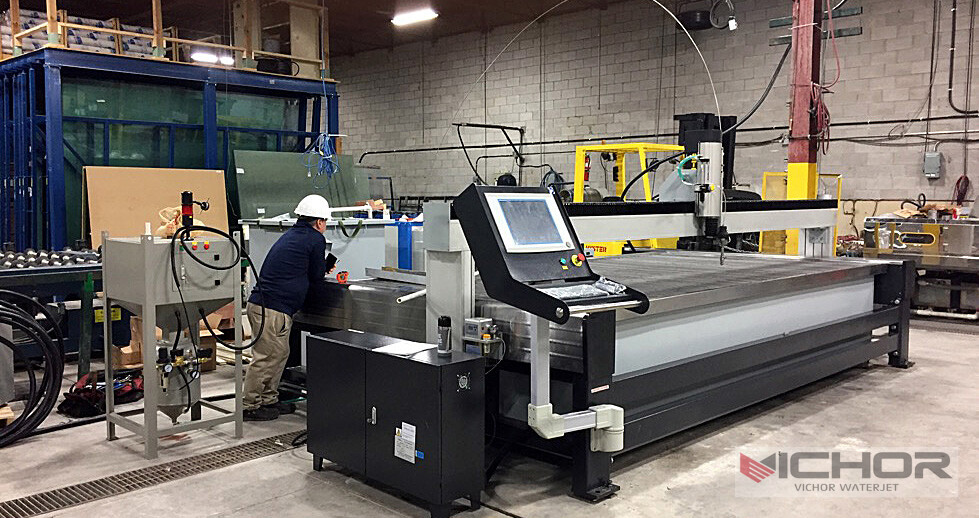
The most advanced are small, integrated CNC benchtop systems. These are complete packages with a controller, cutting table, and pump. They represent a significant investment but offer the closest experience to an industrial machine, though still at a fraction of the power.
A Detailed Cost Analysis: Purchase and Operation
The price of entry is the first reality check. Basic kits start around a few thousand dollars. A capable, small CNC benchtop at home water jet system can easily cost $15,000 to $30,000.
This is far less than a $100,000+ industrial VICHOR system, but still a major investment. Operational costs are continuous. Electricity for the pump and compressor is notable.
Abrasive garnet is a consumable; you will buy it in bags. Pump seals, orifices, and mixing tubes wear out and require replacement. Perhaps the most overlooked cost is water containment and cleanup infrastructure for your workspace.
Service, Support, and the DIY Reality
Service is a critical differentiator from the industrial world. Industrial users like those with VICHOR systems receive professional installation and dedicated support. For the home user, support is often limited to online manuals, forums, and video calls with the supplier.
You become the maintenance technician. Understanding hydraulic diagrams, seal kits, and pump rebuilding is part of ownership. Finding local technicians who understand these specialized systems is nearly impossible.
Your “service plan” is your own mechanical skill and willingness to troubleshoot. This DIY aspect is a major factor that many prospective buyers underestimate when considering an at home water jet.
Practical Solutions for Common Home Shop Challenges
Success requires planning. First, address the mess. A fully enclosed cutting tank with a viewing window is essential. It must be sturdy enough to contain the high-energy slurry without leaking.
Second, manage noise and space. These systems need a dedicated, well-ventilated area, away from living spaces. Sound-dampening enclosures for the pump are highly recommended.
Third, plan for waste. Design a settling tank system to separate abrasive from water. This allows for recycling water and disposing of spent garnet sludge responsibly.
Finally, start with soft materials. Practice on foam, rubber, or thin plastic to learn the machine’s behavior before attempting expensive metal or stone.
An at home water jet cutter is a powerful but demanding tool. It is not an appliance. It is a serious piece of shop equipment that requires significant financial commitment, space, mechanical aptitude, and patience.
For the right person—a dedicated maker, artisan, or small prototyping shop—it can unlock incredible creativity. For most, using a professional jet cutting service for occasional projects remains the more practical and cost-effective solution. The dream of industrial-grade cutting at home is achievable, but it comes with a very specific set of realities that must be weighed carefully.
Frequently Asked Questions (FAQ)
Q1: Can I really cut metal with an at home water jet?
A1: Yes, but with clear limitations. Using an abrasive garnet, a capable home system can cut thin-gauge metals like aluminum, brass, copper, and mild steel, typically up to 1/4 inch (6mm) thick. Cutting speed will be slow, and edge quality on the bottom may show more taper than an industrial cut. It is not for cutting thick steel plate.
Q2: Is an at home water jet safe to operate in a garage?
A2: It can be, with proper precautions. The high-pressure stream is extremely dangerous and can cause severe injury. A fully enclosed cutting chamber is non-negotiable for safety. Electrical systems must be to code for wet environments. Good ventilation is needed. The pump is very loud, requiring hearing protection. Safety planning is paramount.
Q3: How much does the abrasive garnet cost, and where do I get it?
A3: Garnet abrasive is purchased in bags, typically 50-100 lbs. The cost varies by grade and quantity but generally ranges from $0.50 to $1.50 per pound. You will source it from the machine supplier, online industrial abrasives retailers, or sometimes local sandblasting supply companies. It is a recurring operational expense.
Q4: Can I use regular tap water in the system?
A4: It is not recommended. Dissolved minerals in tap water can rapidly clog the tiny orifice (0.010″ or smaller) in the cutting head. This leads to poor performance and frequent downtime. Most systems require filtered or deionized water. Some users install a reverse osmosis (RO) filter specifically for their waterjet pump.
Q5: For a one-off project, is it better to buy a machine or use a service?
A5: For a single project, using a professional jet cutting service is almost always the better choice. You pay only for the cut parts with no capital investment, maintenance, or waste disposal headaches. Services like those using VICHOR industrial machines offer speed, precision on thick materials, and professional finish that a home system cannot match. Purchase only if you have frequent, ongoing need.