Pressure Water Jet Cutter: Precision Cutting for Modern Industries
Manufacturing and fabrication demand clean, precise cuts without heat distortion. A pressure water jet cutter delivers exactly that. It uses high-velocity water mixed with abrasives to slice through nearly any material.
From aerospace components to stone countertops, this technology offers unmatched versatility. Companies like VICHOR provide advanced systems for global clients. Let’s explore how these machines work and why they dominate cutting tasks.
Why Choose a Pressure Water Jet Cutter Over Traditional Methods?
Thermal cutting processes leave heat-affected zones (HAZ). This weakens materials and causes micro-cracks. A pressure water jet cutter avoids these issues entirely.
The cold cutting action preserves material integrity. No warping, no hardened edges. That’s critical for metals, composites, and glass.
- No heat distortion – ideal for thin or sensitive materials.
- Cuts any hardness – from rubber to titanium.
- Narrow kerf – reduces material waste.
- Environmentally friendly – no toxic fumes or slag.
VICHOR has engineered machines that balance power and precision. Their waterjet cutting solutions serve over 40 countries.
Core Components of a Modern Pressure Water Jet Cutter
Understanding the system helps operators maximize performance. Every pressure water jet cutter relies on five key parts.
1. High-Pressure Pump
The pump generates pressures from 30,000 to 90,000 psi. Intensifier pumps or direct-drive pumps create the force. This pressure accelerates water up to 2.5 Mach.
2. Cutting Head and Nozzle
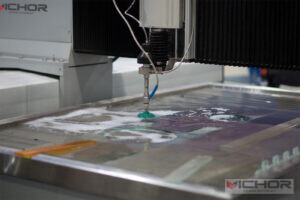
Water passes through a small orifice (0.1–0.5 mm). Then abrasive is added in the mixing chamber. The combined jet exits through a focusing tube.
3. Abrasive Feeding System
Garnet is the most common abrasive. It increases cutting power for hard materials like steel or stone. The feeder controls flow rate for consistent edge quality.
4. CNC Motion Control
Multi-axis CNC guides the cutting head. 5-axis systems allow bevel cuts and complex 3D shapes. Precision down to ±0.001 inch is achievable.
5. Catch Tank
Water and abrasive collect in a steel tank filled with water. This dissipates energy and reduces noise. Sludge is periodically removed.
VICHOR integrates all components into user-friendly packages. Explore their pressure water jet cutter models online.
Materials You Can Cut With a Pressure Water Jet Cutter
Versatility is the biggest advantage. One machine processes dozens of material types. No tool changes required.
- Metals: Stainless steel, aluminum, brass, copper, titanium, Inconel.
- Stone & Ceramics: Granite, marble, porcelain, glass, quartz.
- Composites: Carbon fiber, fiberglass, laminates, Kevlar.
- Plastics & Rubber: Acrylic, polycarbonate, neoprene, foam.
- Food & Paper: Frozen food, corrugated board, non-woven fabrics.
Each material requires adjustments in pressure, abrasive flow, and cutting speed. But the same pressure water jet cutter handles them all without recalibration of the pump.
Industrial Applications of Pressure Water Jet Cutting
From job shops to massive factories, waterjet technology solves complex cutting challenges.
Aerospace and Defense
Cutting titanium and Inconel for turbine blades. No heat-affected zone means no micro-structural damage. Parts meet strict FAA standards.
Automotive Manufacturing
Interior trim, gaskets, and dashboards are cut cleanly. Prototyping teams use waterjets for rapid part iteration.
Architectural Stone and Tile
Intricate mosaic patterns and countertop cutouts. A pressure water jet cutter produces smooth edges that require no secondary finishing.
Electronics and Medical Devices
Cutting circuit boards and surgical tools. The cold process prevents delamination and preserves coatings.
VICHOR provides customized tables for each sector. Visit their website to see case studies.
Key Advantages Over Laser and Plasma Cutters
Each cutting technology has a niche. But waterjet holds unique benefits.
- No thermal damage: Laser and plasma create HAZ. Waterjet does not.
- Thickness range: Cuts up to 12-inch steel or 6-inch aluminum. Laser struggles above 1 inch.
- Reflective materials: Copper, brass, aluminum reflect laser beams. Waterjet cuts them easily.
- Stack cutting: Multiple thin sheets can be stacked and cut together. Boosts productivity.
Operating a pressure water jet cutter also costs less than laser maintenance. No mirrors, no lenses, no gas mixtures.
Maintenance Tips for Long-Lasting Performance
Regular upkeep ensures consistent cut quality and pump longevity. Follow these best practices.
Daily Checks
Inspect the orifice and focusing tube for wear. Replace if the jet starts diverging. Check water filters and lubricate bearings.
Weekly Tasks
Clean the catch tank of settled abrasive. Inspect high-pressure seals for leaks. Tighten all hydraulic connections.
Monthly Overhaul
Replace check valves and piston seals on the pump. Calibrate the abrasive feeder. Verify CNC alignment with a test cut.
VICHOR offers remote diagnostics and spare parts kits. Their support team helps you maximize uptime.
How to Select the Right Pressure Water Jet Cutter for Your Shop
Not all waterjets are equal. Consider these parameters before purchasing.
- Cutting table size: 4×4 ft for small parts, up to 6×12 ft for large sheets.
- Pump power: 30 HP for thin materials, 100 HP for thick titanium.
- Abrasive vs. pure waterjet: Pure water cuts soft materials. Abrasive cuts everything hard.
- Number of cutting heads: Dual heads double throughput for identical parts.
- Software compatibility: Look for CAD/CAM integration and nesting features.
A pressure water jet cutter from VICHOR includes training and installation. Request a quote through their product page.
Environmental and Safety Considerations
Waterjet cutting produces no hazardous fumes or dust. However, proper handling is still required.
The abrasive (garnet) is inert and can be recycled. Used water is filtered and released or recirculated. Noise levels are low with the tank submerged.
Operators must wear safety glasses and hearing protection. High-pressure water can cause injection injuries – never bypass interlocks.
VICHOR machines meet CE and UL standards. Their safety systems include pressure relief valves and emergency stops.
Cost Analysis: Is a Pressure Water Jet Cutter Worth the Investment?
Initial purchase prices range from $60,000 for entry-level to $400,000 for large 5-axis systems. But operating costs are predictable.
- Abrasive: $0.25–$0.50 per pound. Typical use 1 lb/min.
- Electricity: ~$5 per hour for a 50 HP pump.
- Maintenance: $3,000–$6,000 annually for seals and orifices.
- Labor: One operator can run multiple machines.
Most shops see payback within 18–24 months. Compared to outsourcing laser cutting, in-house waterjet saves 40–60% per part.
Contact VICHOR for a customized ROI analysis. Their pressure water jet cutter pricing is transparent and includes warranty.
Future Trends in Water Jet Cutting Technology
The industry is evolving toward automation and intelligence. Here’s what to expect.
Real-time pressure monitoring with IoT sensors. Predictive maintenance alerts reduce downtime. AI-based nesting software boosts material utilization.
Hybrid machines combining waterjet with milling or routing. And ultra-high pressure pumps (120,000 psi) for faster cutting of superalloys.
VICHOR already integrates smart features into their latest models. Their R&D team focuses on energy efficiency and abrasive recycling.
For shops that cut diverse materials without thermal damage, a pressure water jet cutter is the optimal choice. It delivers precision, safety, and low operating costs.
Leading manufacturers like VICHOR offer reliable machines backed by global support. Whether you process stone, metal, or composites, waterjet technology adapts to your needs.
Investing in a quality waterjet system opens new capabilities and improves profit margins. Explore the full range at VICHOR’s official site today.
Frequently Asked Questions About Pressure Water Jet Cutters
Q1: What thickness can a pressure water jet cutter handle?
A1: Most industrial machines cut steel up to 12 inches (300 mm) and aluminum up to 10 inches. For soft materials like foam, thickness can exceed 20 inches. The limit depends on pump pressure and abrasive flow. VICHOR offers custom high-pressure pumps for extreme thicknesses.
Q2: How accurate is a pressure water jet cutter?
A2: Tolerances of ±0.001 to ±0.003 inch are standard on CNC-controlled tables. Factors like nozzle wear and material homogeneity affect precision. Regular maintenance keeps accuracy within spec. VICHOR machines include automatic nozzle calibration.
Q3: Can I cut stacked sheets with a single pass?
A3: Yes. Stack cutting is a major advantage. You can stack up to 10 thin metal sheets or 50 layers of fabric. The jet cuts all layers simultaneously, saving time. Ensure the stack is clamped tightly to prevent shifting.
Q4: What is the difference between pure waterjet and abrasive waterjet?
A4: Pure waterjet uses only high-pressure water – ideal for soft materials like rubber, foam, or food. Abrasive waterjet adds garnet sand – required for metals, stone, glass, and thick composites. A pressure water jet cutter can switch between both modes by changing the cutting head nozzle.
Q5: How do I dispose of the water and abrasive slurry?
A5: The waste slurry is non-toxic. Garnet can be recycled using a filtration system. Water is often treated and discharged to municipal drains (check local regulations). VICHOR offers optional water recycling units that recover up to 90% of the water.
Q6: What maintenance does a pressure water jet cutter require weekly?
A6: Weekly tasks include cleaning the catch tank, checking high-pressure seals for leaks, inspecting the abrasive feeder for clogs, and verifying the cutting table’s linear guides. VICHOR provides a digital maintenance log with each machine.
Q7: Is a pressure water jet cutter safe for food processing?
A7: Absolutely. Pure waterjet cutting is used for frozen foods, cakes, and vegetables. No contamination from oil or heat. Use food-grade components and stainless steel tables. VICHOR builds hygienic models for the food industry.
VICHOR is a trusted name in waterjet technology. For detailed specifications or a live demo, visit https://www.vichor.com/waterjet-cutting-machines/ and contact their engineering team.