Precision at Scale: The Engineering Superiority of Professional Abrasive Waterjet Services
In the demanding ecosystems of aerospace, defense, and heavy industrial fabrication, the margin between a functional component and a costly failure is often measured in microns. For over two decades, the industry standard for cold-cutting versatility has been defined by abrasive waterjet services. Unlike thermal processes that compromise material integrity, abrasive waterjet technology leverages high-velocity garnet and ultra-high-pressure water to deliver mechanical cuts without heat-affected zones (HAZ), mechanical stress, or chemical distortion.
This article dissects the technical nuances, economic rationales, and application-specific advantages of advanced abrasive waterjet services. We will navigate through the physics of abrasive entrainment, the selection of cutting parameters for exotic alloys, and how modern service providers—such as VICHOR—are redefining operational efficiency through both fixed-installation and mobile industrial cutting units.
1. The Physics of Precision: How Abrasive Waterjet Cutting Achieves Material Versatility
To truly appreciate the sophistication of professional abrasive waterjet services, one must understand the fundamental mechanics. The process involves three critical stages: ultra-high-pressure water generation (typically 60,000 to 90,000 PSI), abrasive metering, and focused beam delivery. The abrasive—usually 80-mesh garnet—is introduced into the water stream within a mixing tube, creating a coherent jet traveling at supersonic speeds (exceeding Mach 3).
Parameter Optimization for Exotic Alloys
When cutting materials like Inconel 718, titanium grade 5, or hardened tool steel (up to 60 HRC), service engineers calibrate specific parameters to balance cut speed with edge quality. Key variables include:
- Abrasive flow rate: Typically 0.5 to 1.5 lbs/min; higher rates improve cut speed in thick sections but increase operational cost.
- Traverse speed: Adjusted dynamically via CNC to maintain kerf consistency. For a 1-inch stainless steel plate, speeds range between 4 to 8 inches per minute.
- Orifice & mixing tube geometry: Diamond orifices (0.010” to 0.020”) ensure longevity and precision. Tungsten carbide mixing tubes withstand the abrasive erosion, requiring replacement after 80-120 hours of cutting.
Data from ISO 9013 standards indicate that abrasive waterjet cutting consistently achieves cutting quality range 1 to 3 (the highest classifications), with perpendicularity tolerances of ±0.001” to ±0.003” depending on material thickness. This repeatability is why abrasive waterjet services are mandatory for components requiring secondary machining or welding, as the lack of thermal stress eliminates post-cut warpage.
2. Industry Pain Points: Why Thermal Cutting Falls Short
Laser, plasma, and flame cutting dominate certain sectors, yet they introduce three critical failure modes that sophisticated manufacturers cannot tolerate:
- Heat-Affected Zone (HAZ): Thermal cutting alters the metallurgical structure. In aerospace, a recast layer or micro-cracks from laser or EDM can lead to premature fatigue failure. Abrasive waterjet services produce a cold-cut edge, preserving the original material properties.
- Mechanical Stresses: Blanking, punching, or shearing induces residual stresses. For large-format gaskets or thin-walled structures, this leads to distortion. Waterjet cutting exerts negligible lateral force (typically < 1 lb), enabling the cutting of delicate honeycomb panels or thin foils without deformation.
- Material Limitations: Reflective materials (copper, brass, aluminum) damage laser optics. Thick composites (carbon fiber, fiberglass) delaminate under sawing. Abrasive waterjet services handle these materials seamlessly, with no risk of delamination or reflective damage.
Consider a case study from a heavy equipment manufacturer: replacing plasma-cut wear plates (AR500 steel) with waterjet-cut components reduced assembly rejection rates by 34% due to elimination of dross and improved weld fit-up. Such metrics demonstrate the direct ROI of switching to high-precision abrasive waterjet services.
3. Application Domains: From Aerospace to Architectural Metals
The versatility of modern abrasive waterjet services spans industries where material integrity is non-negotiable. Below is a breakdown of key sectors and the specific engineering benefits realized:
Aerospace & Defense
Components such as turbine engine mounts, titanium structural frames, and composite cockpit panels require burr-free edges and strict tolerances. Abrasive waterjet cutting eliminates the need for secondary deburring and avoids the micro-cracking associated with laser cutting of carbon-fiber-reinforced polymers (CFRP).
Industrial Automation & Robotics
Precision gear racks, fixture plates, and robotic end-of-arm tooling often incorporate hardened steel (50-62 HRC). Traditional machining of hardened materials requires slow EDM or expensive carbide tooling. Abrasive waterjet services cut these components directly from the hardened blank, reducing lead times by up to 60%.
Architectural & Ornamental Metals
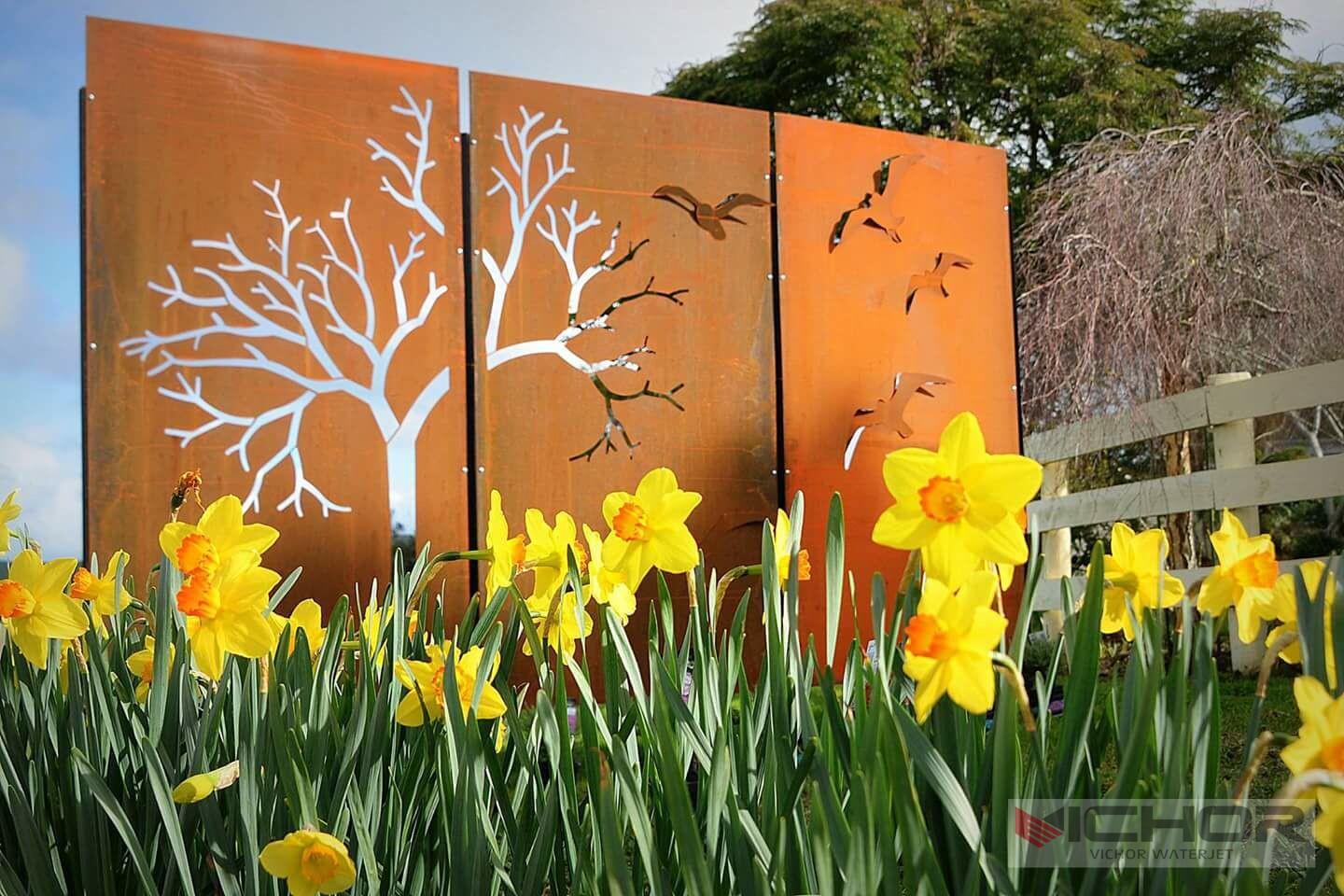
For high-end architectural features—bronze screens, stainless steel cladding, or granite inlays—the process delivers seamless edge quality that requires minimal finishing. Thick stone (up to 6 inches) and glass (up to 2 inches) are cut without chipping, preserving the aesthetic integrity of the material.
On-Site Industrial Fabrication
One of the most significant advancements in the field is the advent of mobile units. For industries such as mining, shipbuilding, and offshore oil rigs, transporting large components to a fixed facility is logistically prohibitive. Abrasive waterjet services delivered via portable systems allow for in-situ modifications, such as cutting access ports into pressure vessels, modifying blast furnace liners, or performing precision demolition on concrete structures with minimal vibration.
4. Economic Analysis: Total Cost of Ownership in Outsourced Cutting
When evaluating abrasive waterjet services, procurement teams often focus solely on the cost per square inch. However, a true cost-benefit analysis must incorporate downstream savings. Key economic drivers include:
- Nesting efficiency: Advanced CAD/CAM software with true-shape nesting can achieve material utilization rates exceeding 85%, compared to 60-70% with traditional punching or sawing.
- Secondary operations reduction: Because waterjet leaves a clean, burr-free edge, secondary milling, grinding, or deburring costs are often eliminated entirely.
- Inventory optimization: The ability to cut near-net-shape parts from a single sheet reduces work-in-progress (WIP) inventory and streamlines just-in-time (JIT) manufacturing schedules.
For high-mix, low-volume production—common in medical device prototyping or custom machinery—abrasive waterjet services offer rapid turnaround without the need for hard tooling. A single CNC program can switch from cutting 0.5” aluminum to 2” titanium in seconds, enabling unparalleled manufacturing agility.
5. Quality Assurance and Certification Protocols
True industry leaders in abrasive waterjet services operate under rigorous quality management systems. For mission-critical industries, service providers must demonstrate compliance with:
- AS9100D: Aerospace quality standard requiring full traceability of materials and processes.
- ISO 9001:2015: General manufacturing quality, ensuring consistent process control.
- Nadcap (National Aerospace and Defense Contractors Accreditation Program): For special processes, including non-conventional machining.
Reputable providers like VICHOR incorporate real-time monitoring of cutting parameters—including pump pressure, abrasive flow consistency, and nozzle wear—to maintain statistical process control (SPC). Each job is accompanied by detailed inspection reports, including surface finish measurements (Ra values) and dimensional reports generated via CMM or laser scanning.
6. The Environmental Edge: Sustainability in Waterjet Cutting
In an era where manufacturing sustainability is paramount, abrasive waterjet technology offers distinct environmental advantages over chemical etching or thermal cutting. Key sustainability metrics include:
- Zero hazardous emissions: No fumes, no oil mist, and no slag or hazardous airborne particles. The spent abrasive (garnet) is inert and can be recycled into concrete aggregate or road base.
- Water conservation: Closed-loop filtration systems recycle up to 95% of the process water. Modern systems utilize on-demand high-pressure pumps that reduce energy consumption by 30-40% compared to continuous-run hydraulic intensifiers.
- Material recovery: Because the process is a true cold cut, scrap material remains uncontaminated and fully recyclable, without the oxidation that occurs with plasma cutting.
By leveraging abrasive waterjet services with integrated recycling systems, manufacturers can significantly reduce their carbon footprint while adhering to stringent environmental regulations such as RoHS and REACH.
7. Future Trends: Automation, AI, and Robotic Integration
The next frontier for abrasive waterjet services lies in intelligent automation. Industry 4.0 implementations are now incorporating:
- Adaptive cutting: Using laser displacement sensors to map material surface variations in real-time, dynamically adjusting nozzle standoff distance to maintain cut accuracy on warped or uneven plates.
- Predictive maintenance: IoT-enabled pumps monitor seal wear, hydraulic oil temperature, and orifice erosion, alerting operators before a critical failure occurs, thereby maximizing uptime.
- Robotic waterjet cutting: 6-axis robotic arms equipped with abrasive waterjet heads are now used for 3D trimming of complex castings, automotive interior components, and even titanium aerospace brackets, eliminating the need for expensive 5-axis machining centers.
As these technologies mature, the capability gap between traditional subtractive manufacturing and abrasive waterjet continues to narrow, solidifying its role as a primary manufacturing process rather than a secondary finishing operation.
Frequently Asked Questions (FAQ)
Q1: What is the maximum thickness that professional abrasive waterjet services can cut?
A1: While standard abrasive waterjet services efficiently handle materials up to 6 inches (152 mm) in steel and 10 inches (254 mm) in aluminum, specialized high-pressure systems (up to 90,000 PSI) can cut titanium and stainless steel up to 12 inches thick. However, productivity declines with extreme thickness; for materials exceeding 4 inches, we typically recommend a feasibility analysis to balance cut speed, edge quality, and cost.
Q2: Can abrasive waterjet cutting be used for composite materials without causing delamination?
A2: Yes, this is one of the primary advantages. Unlike sawing or laser cutting, which generate heat and mechanical force leading to delamination or fiber pullout, abrasive waterjet cutting uses a cold, focused stream. For carbon fiber, glass fiber, and Kevlar composites, parameters are optimized to reduce abrasive flow and increase traverse speed, ensuring the matrix and fibers are cut cleanly without inter-laminar separation.
Q3: How does on-site abrasive waterjet cutting differ from fixed-table services?
A3: On-site or mobile abrasive waterjet services, such as those offered by VICHOR, utilize track-mounted or robotic systems that travel to the workpiece. This is ideal for large-scale industrial components (e.g., ship propellers, mining equipment, pressure vessels) that cannot be easily transported. Mobile systems maintain the same precision as fixed tables—often ±0.005”—and include integrated water recycling units to comply with site environmental regulations.
Q4: What tolerances can I expect for precision components?
A4: For high-precision abrasive waterjet services, achievable tolerances are typically ±0.002” to ±0.005” for materials under 2 inches thick. With advanced dynamic waterjet (DWJ) heads that compensate for jet lag and taper, tolerances can be held to ±0.001” over the entire cut path. Final tolerance depends on material type, thickness, and part geometry; a DFM (Design for Manufacturing) review is recommended for critical dimensions.
Q5: How does garnet abrasive recycling work, and does it affect cut quality?
A5: Professional service providers often employ garnet recycling systems that separate reusable abrasive from sludge and fines. Recycled garnet (typically >80% virgin performance) is suitable for rough cutting or applications where edge finish is less critical. For high-precision aerospace or medical components, virgin abrasive is always used to ensure consistency of cut speed and surface finish. Recycling reduces disposal costs by up to 70% and aligns with sustainable manufacturing practices.
Q6: What is the typical lead time for complex multi-material projects?
A6: Lead times vary based on nesting complexity and material availability. For standard metals and plastics, abrasive waterjet services typically offer 24- to 72-hour turnaround for prototype quantities (1-50 parts). For production runs exceeding 1,000 parts, lead times generally range from 5 to 10 business days, depending on material procurement and machine scheduling. Providers with in-house CNC programming and automated material handling, such as VICHOR, frequently offer expedited services for critical deadlines.
Q7: Are there any materials that cannot be cut with abrasive waterjet?
A7: While the process is exceptionally versatile, tempered glass and some hardened ceramics are prone to fracturing due to the impact force. Additionally, materials that degrade when wet, such as certain non-hermetic electronic assemblies or moisture-sensitive powdered metals, are not suitable for waterjet cutting. For all other materials—including hardened steel, titanium, Inconel, stone, and composites—abrasive waterjet remains the optimal non-thermal solution.