Marble Waterjet Cutting: Benefits, Costs and How to Choose a Service
Marble has captivated architects and designers for millennia with its unique veining and timeless elegance. However, transforming raw slabs into intricate works of art or precision architectural elements has always been a challenge. Traditional cutting methods often fall short, limited by heat, dust, and the risk of fracturing the delicate stone. This is where marble waterjet cutting emerges as the definitive modern solution. By harnessing a supersonic stream of water and abrasive, this cold-cutting process shapes marble with unparalleled accuracy and zero thermal damage. Whether you are a fabricator, an architect specifying a project, or an artist, understanding the capabilities of marble waterjet cutting is essential for pushing the boundaries of design.
Core Information: How It Works and Why It’s Superior
The process is a fascinating blend of simplicity and high technology. An ultra-high-pressure pump, typically generating between 60,000 to 90,000 PSI, forces water through a tiny gemstone orifice. This creates a coherent stream moving faster than the speed of sound.
For cutting marble, a hard abrasive material, usually garnet sand, is injected into this water jet. The abrasive particles are accelerated to such a high velocity that they erode the marble through micro-machining.
The key advantage is the complete absence of heat. Unlike saws or lasers, marble waterjet cutting does not create a heat-affected zone. This means no thermal stress, which eliminates the risk of cracking, discoloration, or weakening the crystalline structure along the cut line.
This cold-cutting capability preserves the inherent strength and beauty of the marble, making it the safest method for delicate or expensive slabs.
Comparing Marble Waterjet Cutting to Traditional Methods
To appreciate its value, a direct comparison is useful. Traditional diamond saws and routers are effective for straight cuts and simple edges. However, they generate significant dust, noise, and vibration. Most critically, they struggle with complex geometries and sharp interior corners.
CNC routers can create reliefs and textures but are limited in the sharpness of detail and produce substantial waste as marble dust.
Marble waterjet cutting stands apart. It produces minimal dust as the water suppresses particles. It can cut any 2D shape, no matter how complex, with razor-sharp precision. There is virtually no tooling force, so even thin or fragile pieces can be cut without chipping.
For detailed inlays, logos, or intricate patterns, no other method offers the same combination of precision and material integrity.
Applications and Project Inspiration
The possibilities with marble waterjet cutting are vast. In high-end residential and commercial interiors, it is used for far more than countertop cutouts.
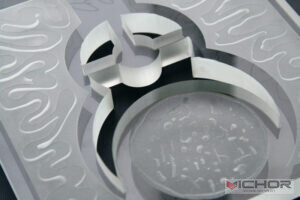
Think of elaborate kitchen splashbacks with custom mosaic patterns, vanity tops with integrated, perfectly cut sink bowls, and feature walls with intricate geometric or organic designs. Floor inlays for logos or decorative borders are another popular application.
Architects specify it for ventilated façade panels with complex perforations, detailed signage, and bespoke cladding elements. Artists and sculptors utilize the technology to create detailed marble artwork, layered portraits, and puzzle-like installations that would be impossible to achieve by hand.
A Guide to Choosing the Right Service or System
You have two main paths: outsourcing to a service provider or investing in your own equipment. For outsourcing, due diligence is key. Look for a shop with a proven portfolio in marble waterjet cutting.
Examine the quality of their cuts, especially on intricate samples. Ask about their slab handling capabilities and the size of their cutting bed. A provider using industrial-grade equipment from manufacturers like VICHOR often indicates a commitment to precision and reliability.
If your volume justifies an in-house system, the choice becomes more technical. For marble, a robust pump (50HP or more) is needed to maintain pressure for consistent cuts. The cutting table must be stable to handle heavy slabs without vibration. Software should allow for efficient nesting of parts to minimize material waste.
Understanding Costs and Pricing Factors
Costs for marble waterjet cutting are rarely linear. They are calculated based on several variables. The primary cost driver is “cut time,” which is influenced by the complexity of the design and the thickness of the marble. A simple, straight line is fast and inexpensive. A dense, intricate filigree pattern takes much longer.
Material type plays a role. Softer marbles may cut slightly faster than harder, quartz-rich varieties. The overall size of the job and the efficiency of part nesting also affect the final price.
For fabricators considering a machine, the capital investment is significant but must be weighed against new revenue streams. The ability to offer complex inlays, reduce material waste through optimal nesting, and complete jobs in a single setup can deliver a strong return on investment over time.
Technical Insights and Achieving the Best Results
Achieving flawless results in marble waterjet cutting relies on technique and technology. The “lag” or natural taper of the jet must be managed. Advanced cutting heads with taper compensation or 5-axis capability can tilt the nozzle to produce perfectly square edges on thicker material.
Cutting speed is critical. Going too fast can lead to a rough, striated edge finish. The optimal speed is a balance between productivity and achieving the desired edge quality, which for marble is often a smooth, honed finish straight from the jet.
Post-processing is usually minimal. The waterjet edge has a fine, matte texture. A light polishing with diamond pads is typically all that’s needed to bring it to a desired sheen, as the base cut is so uniform.
Using a high-performance system engineered for stone, such as those from VICHOR, ensures the stability and control needed to execute these technical parameters consistently.
For anyone working with marble, marble waterjet cutting is no longer a niche luxury but a fundamental capability. It bridges the gap between the ancient beauty of natural stone and the limitless potential of digital design. It empowers creation without compromise, protecting the material while enabling breathtaking complexity. Whether you partner with a skilled service provider or invest in technology from leaders like VICHOR, integrating this process is a definitive step towards future-proofing your craft and captivating your clients.
Frequently Asked Questions (FAQ)
Q1: What does the edge look like straight from the waterjet? Is it smooth?
A1: The edge from a marble waterjet cutting process has a consistent, fine matte texture. It is smoother than a sawn edge but not polished. It resembles a nicely honed finish. This provides an excellent base for final polishing, which is achieved quickly with standard diamond polishing pads.
Q2: Can waterjet cutting handle the most delicate and expensive marbles, like Statuario?
A2: Yes, it is ideally suited for delicate and valuable marbles. Since it is a cold, non-contact process with minimal vibration, it poses virtually no risk of cracking or damaging fragile slabs. This makes marble waterjet cutting the preferred method for high-risk, high-value materials where preserving integrity is paramount.
Q3: Is there a maximum thickness for cutting marble with a waterjet?
A3: While there are practical limits, industrial waterjets can cut marble over 4 inches (100mm) thick. The cutting speed decreases with thickness, and managing the water stream’s natural taper becomes more important. For most architectural and design applications, standard slab thicknesses (2cm, 3cm) are handled with ease.
Q4: How does the cost compare to hand-carving for complex designs?
A4: For highly complex or repetitive patterns, marble waterjet cutting is almost always more cost-effective than skilled hand-carving. It is dramatically faster, perfectly accurate, and repeatable. Hand-carving remains valuable for truly organic, sculptural 3D forms, but for precise 2D intricacies, waterjet is the economical and superior choice.
Q5: Why is equipment from a brand like VICHOR recommended for marble?
A5: VICHOR designs systems with the stone industry’s demands in mind. Their pumps deliver stable high pressure for consistent cut quality in hard materials, and their gantries are built for the heavy, precise movement required for slabs. This engineering focus on stability and reliability minimizes errors and waste, which is crucial when working with costly marble. Their global support also ensures technical assistance is available.