
How Abrasive Water Jet Machining Works and Where to Use It
If you’re dealing with tough materials like hardened steel, thick granite, or advanced composites, you know how quickly traditional cutting tools can fail. They wear down, overheat, or simply can’t handle the job without damaging the material. This is where abrasive water jet machining comes into play. It’s not just another cutting method; it’s a fundamentally different approach that solves problems other processes create.
Imagine cutting through eight inches of stainless steel without a single spark. Picture slicing intricate shapes from brittle glass without a crack. That’s the reality of modern abrasive waterjet cutting. It combines sheer power with pinpoint accuracy, all while keeping the material stone-cold.
This technology has moved from a niche specialty to a mainstream manufacturing essential. From aerospace factories to local machine shops, it’s the go-to solution for parts that are too thick, too hard, or too sensitive for lasers, plasma, or mills. Let’s get into what makes it tick and how it might fit into your operation.
The Core Principle: How It Actually Cuts
The process seems almost simple in theory, but the engineering is precise. A standard high-pressure pump, often from a brand like VICHOR, intensifies water to extreme pressures—typically 60,000 to over 90,000 PSI.
This ultra-high-pressure water is then forced through a tiny gemstone orifice, creating a supersonic stream. At this point, it’s just a pure waterjet, powerful enough to cut soft materials.
For hard materials, the key ingredient is introduced. A precisely metered stream of abrasive garnet sand is sucked into this water stream inside a mixing chamber. The water accelerates the abrasive particles to tremendous speeds.
This combination transforms the water from a cutter into a transporter. The abrasive water jet cutter does the real work through micro-erosion. The garnet particles literally scratch away material particles, one grain at a time, along a computer-controlled path. It’s controlled erosion, not melting or shearing.
What Can You Cut? The Unmatched Material Versatility
This is the biggest selling point. An abrasive water jet machining system doesn’t care about a material’s hardness, reflectivity, or conductivity. Its material list is incredibly long.
Metals are the most common application. It handles everything from soft aluminum and copper to tough titanium, tool steel, and hardened armor plate. There is no thermal distortion, so the metal’s properties remain unchanged.
Stone and tile work is another major area. It can cut complex designs in granite, marble, and ceramic without chipping the edges, something routers often struggle with.
Composites and layered materials are where it truly shines. It cleanly cuts carbon fiber, Kevlar, and fiberglass without fraying or delaminating the layers. This is critical in aerospace and automotive industries.
The list goes on: glass, rubber, plastics, bulletproof materials, and even explosives. If you can put it on the table, a waterjet cutting machine can probably cut it.
Abrasive Waterjet vs. Other Cutting Technologies
Why choose this over a laser, plasma, or a good old bandsaw? Each has a place, but waterjet fills a unique gap.
Compared to laser cutting, abrasive water jet machining wins on material thickness and lack of heat. Lasers struggle with reflective materials (like copper) and thicknesses over an inch. They also create a heat-affected zone (HAZ) that can weaken metal. Waterjet has no HAZ.
Against plasma cutting, waterjet wins on precision and edge quality. Plasma is fast and great for thick steel, but it leaves a wide, heat-hardened kerf with a beveled edge. A waterjet cut is narrow, square, and ready for welding.
Compared to mechanical machining (milling, sawing), waterjet wins on flexibility and tooling cost. There’s no need for expensive, material-specific tooling. You can switch from cutting titanium to cutting foam by just changing a file on the computer. There’s also no direct tool pressure, so you can cut delicate, thin parts without clamping distortion.
Understanding the Costs: Investment and Operational Expenses
Let’s talk numbers. A new industrial abrasive waterjet cutting system represents a significant capital investment. Prices can range from around $100,000 for a basic model to well over $500,000 for a large-format, high-pressure system with automation.
The major cost drivers are the pump’s horsepower (which dictates pressure and speed), the size and rigidity of the cutting table, and the sophistication of the CNC controls.
However, the purchase price is only part of the story. The ongoing operational costs are crucial for your ROI calculation.
The largest consumable cost is the abrasive garnet. Depending on usage, a shop can go through hundreds or thousands of pounds per week. High-pressure pump parts—like seals, valves, and intensifier components—are wear items with scheduled replacement cycles.
The true economic justification isn’t in cheap cutting, but in value-added cutting. It comes from reducing secondary operations (like milling or stress-relieving), minimizing material waste through tight nesting, and the ability to take on complex, high-margin jobs that others can’t handle.
Key Components of a Reliable Waterjet System
Not all machines are built the same. When evaluating an abrasive water jet machining system, pay attention to these core components.
The Pump is the heart. Look for stable pressure output (critical for consistent cut quality) and a reputation for durability. Pumps from manufacturers like VICHOR are known for robust design that stands up to multi-shift industrial use.
The Motion System is the backbone. A stiff, vibration-free gantry with precision linear drives ensures the cutting head moves exactly as programmed. A wobbly frame will ruin accuracy, no matter how good the pump is.
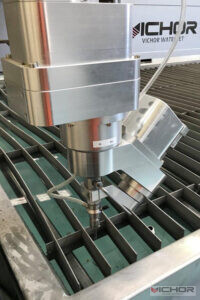
The Cutting Head is the business end. A well-designed head mixes water and abrasive efficiently for a focused, consistent stream. Features like automatic height control and tapered hole-cutting compensation are signs of an advanced system.
The Controller and Software are the brain. User-friendly, powerful software translates your CAD drawings into efficient cutting paths, manages abrasive feed rate, and helps nest parts to save material.
Finding the Right Service Provider or Machine Supplier
Whether you’re looking to outsource parts or buy your own machine, choosing the right partner is critical.
For job shops needing service, look for a provider with a portfolio in your industry. Ask about their material capabilities, maximum thickness, and tolerance guarantees. A shop with a VICHOR machine, for instance, is likely equipped for serious, high-precision industrial work.
If you’re investing in a machine, consider the total package. The machine’s specs are important, but the supplier’s support network is what ensures its longevity. You need reliable access to technical support, spare parts, and operator training.
A global brand’s value often lies in this support infrastructure. They can provide preventative maintenance schedules, remote diagnostics, and factory-trained technicians to minimize costly downtime.
The Role of Technology Leaders Like VICHOR
In a competitive international market, brands differentiate themselves through reliability and innovation. VICHOR has established a strong presence by focusing on core industrial principles: durability, stable performance, and operational efficiency.
Their abrasive water jet machining systems are engineered to deliver consistent high pressure, which directly translates to faster cutting speeds and better edge quality over the life of the machine. For a machine shop owner, this means predictable performance and lower cost-per-part.
They compete not on gimmicks, but on building a machine that runs day after day with minimal fuss. This practical approach resonates with businesses where the waterjet is a production asset, not just a prototype tool.
Frequently Asked Questions (FAQs)
Q1: What is the typical accuracy and tolerance of abrasive waterjet machining?
A1: A well-calibrated industrial abrasive water jet machining system can consistently hold tolerances of ±0.003” to ±0.005” (±0.076mm to ±0.127mm) on parts under 1-inch thick. Taper (where the kerf is wider at the bottom) can occur on thicker materials, but advanced systems use software and cutting head adjustments to compensate for it.
Q2: How thick of a material can it actually cut through?
A2: It can cut remarkably thick materials. In mild steel, 6 to 8 inches is common. In softer materials like aluminum or composite, even 10+ inches is possible. The main limitation becomes cutting speed—it gets slower as thickness increases—and a slight taper on the cut edge.
Q3: Is the abrasive waterjet process environmentally friendly?
A3: It is considered a relatively clean process. It creates no hazardous fumes or gases. The primary waste is wet sludge—a mixture of water, spent abrasive (natural garnet), and microscopic particles of the cut material. This sludge is non-toxic and can often be disposed of in a landfill or processed to recover water. Water itself is not recycled in the high-pressure stream.
Q4: What materials are NOT suitable for abrasive waterjet cutting?
A4: Very few. Tempered glass and polycarbonate can crack due to the water impact. Some very soft, unfused materials (like certain loose felts) might not cut cleanly. Diamond and hardened ceramics are too hard for the garnet abrasive to cut efficiently. For over 95% of industrial materials, it is a viable option.
Q5: How does operating cost compare to laser cutting for thin metals?
A5: For thin metals (under 1/4 inch), laser cutting is generally faster and has a lower per-hour operating cost, as it uses no abrasive. However, the abrasive water jet machining process adds no heat, leaving a stronger edge with no hardening. The “cost” comparison must include part quality. If you need a perfect, stress-free edge for a critical component, the waterjet’s slightly higher operational cost is often justified by the superior result.