How a 5 Axis Water Jet Cutting Machine Can Transform Your Manufacturing Business
I still remember the frustration of walking through a fabrication shop floor a few years ago. We had just finished cutting a set of thick steel plates on a standard 3-axis water jet. The cut quality was decent, but the edges had that characteristic “V” taper. We spent the next four hours with angle grinders and a milling machine just to square up the edges and prep them for welding. It felt like a waste of time and skilled labor.
If you are reading this, you are likely in a similar boat. You are tired of secondary operations. You are looking at part drawings that require compound angles or precise chamfers, and you are wondering if there is a better way.
The answer lies in the 5 axis water jet cutting machine. This isn’t just a minor upgrade; it is a fundamental shift in how we approach cutting. Whether you are in aerospace, stone fabrication, or heavy machinery, understanding this technology is the key to bidding on high-value jobs. Let’s look at what this machine actually does and why it is becoming the new standard for serious fabricators.
What Actually Makes it “5 Axis”?
Most people are familiar with the standard X, Y, and Z movements. The head moves left, right, forward, backward, up, and down. On a standard machine, the nozzle is always perpendicular to the table. It points straight down.
A 5 axis water jet cutting machine introduces two additional movements: the A-axis and the C-axis. The A-axis allows the cutting head to tilt away from the vertical position. The C-axis allows the head to rotate around the Z-axis.
When you combine these, you get a cutting head that can articulate in any direction. It can tilt up to 60 or even 90 degrees depending on the manufacturer. This articulation is not just a gimmick; it is the secret sauce that allows a 5 axis water jet cutting machine to perform feats that a fixed head simply cannot touch.
Solving the Taper Problem Forever
The biggest complaint about water jet technology has always been “taper.” As the water stream cuts through material, it loses energy. This causes the cut to be wider at the top and narrower at the bottom. On thin sheet metal, you might not notice it. On 2-inch thick aluminum, it is obvious.
A 5 axis water jet cutting machine solves this through dynamic compensation. The controller knows exactly how much taper to expect based on the material thickness and cutting speed. It automatically tilts the cutting head slightly.
By tilting the nozzle, the machine forces the taper into the scrap side of the material. The result? The edge of your part is perfectly square. You can stack parts, fit them into tight assemblies, or weld them immediately. This capability alone is often worth the investment in a 5 axis water jet cutting machine.
Weld Preparation without Grinding
In the heavy industry sector, welding is everything. But you cannot just weld two thick plates together; you have to bevel the edges to ensure full penetration.
Traditionally, this meant cutting the part flat, then moving it to a machining center, or worse, having a guy with a grinder attack it manually. It is slow, dirty, and inaccurate.
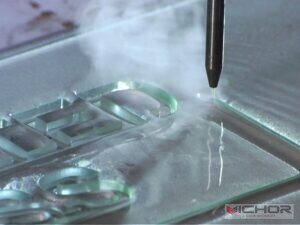
A 5 axis water jet cutting machine can cut these bevels in a single pass. We are talking about V-bevels, K-bevels, and Y-bevels. Because the water jet is a cold cutting process, there is no Heat Affected Zone (HAZ). The welder gets a clean, cold, oxide-free surface.
Companies utilizing VICHOR technology have reported cutting their prep time by over 50% simply by switching to 5-axis beveling. It turns a multi-step workflow into a “done in one” operation.
True 3D Cutting Capabilities
While squaring edges and beveling plates are common, the true potential of a 5 axis water jet cutting machine is unlocked in 3D cutting. This is where the machine stops being a plate cutter and starts being a sculpting tool.
Imagine a curved pipe that needs a hole cut into the side. A 3-axis machine would distort the hole because the distance from the nozzle to the pipe surface changes. A 5-axis head follows the contour of the pipe, keeping the nozzle perpendicular to the surface at all times.
This is critical in the aerospace industry. Carbon fiber wing sections, titanium turbine blades, and complex composite housings often require trimming after they are molded. A 5 axis water jet cutting machine can trim these 3D shapes with incredible precision, without the risk of delamination that comes with mechanical router bits.
The Role of Software in 5-Axis Operations
Hardware is only half the battle. The complexity of moving five axes simultaneously requires robust software. In the early days, programming a 5 axis water jet cutting machine required a degree in mathematics. Today, it is much simpler.
Modern CAM (Computer-Aided Manufacturing) software handles the heavy lifting. You import your 3D model (like a STEP or IGES file), select the edges you want to cut, and input the material type.
The software calculates the tool path. It manages the “Tool Center Point” (TCP), ensuring that even as the head tilts and rotates, the stream enters the material at the exact right coordinate. VICHOR systems are known for integrating seamlessly with top-tier nesting and programming software, ensuring that the learning curve for operators is manageable.
Comparing Costs: Is it Worth the Premium?
Let’s be honest about the price. A 5 axis water jet cutting machine is more expensive than a 3-axis model. You are paying for the articulating head, more complex motors, and advanced control systems.
However, you must look at the Total Cost of Ownership (TCO) and the cost per part. If a 3-axis machine cuts a part for $50, but you spend another $50 on secondary machining to square the edges, the part costs $100.
If a 5 axis water jet cutting machine cuts the same part for $60 (due to slightly slower speeds when tilting), but the part comes off the table finished, you have saved $40 per part. The ROI becomes visible very quickly for shops that handle thick materials or require precision.
Versatility Across Industries
One of the reasons the search volume for 5 axis water jet cutting machine is climbing is its versatility. It is not locked into one industry.
Stone and Tile:
Fabricators use it to cut mitered edges on granite countertops. This allows them to glue pieces together to create “waterfall” edges or thick-looking slabs without the weight. A VICHOR 5-axis system can cut these miters perfectly so the glue lines are almost invisible.
Automotive:
Prototyping shops use it to trim thermoformed plastic parts and interior carpets. The water jet cuts clean without melting the edges, which is a common problem with lasers.
Defense:
Cutting armored steel requires cold processes to maintain the ballistic rating of the metal. The 5 axis water jet cutting machine can cut complex armored panels with beveled edges for fitting onto vehicles.
Maintenance of the 5-Axis Head
A common concern I hear from shop managers is maintenance. “Doesn’t the moving head break down?”
It is true that a 5-axis head has more moving parts than a fixed head. It has rotary unions, bearings, and flexible high-pressure tubing. However, engineering has advanced significantly.
Brands like VICHOR design their cutting heads to withstand the harsh, abrasive environment. They use positive air pressure inside the head to blow air out. This prevents water and garnet dust from creeping into the bearings. While a 5 axis water jet cutting machine does require a disciplined maintenance schedule, it is no longer the maintenance nightmare it was twenty years ago.
Choosing the Right Manufacturer
When you are ready to invest, who you buy from matters as much as what you buy. You are not just buying a collection of pumps and motors; you are buying a capability.
You need a partner who understands the kinematics of 5-axis cutting. VICHOR has positioned itself as a leader in the international water jet field by focusing on the stability of the cut.
Accuracy in 5-axis cutting depends on the rigidity of the machine frame. If the machine vibrates while the head is tilted 45 degrees, your part will be out of tolerance. VICHOR builds heavy, thermally stable frames that ensure the 5 axis water jet cutting machine remains accurate over years of heavy use.
The Future is Multi-Axis
The manufacturing world is moving away from simple flat parts. Designers are pushing the limits with complex geometries and exotic materials.
Shops that stick to basic 2D cutting will find themselves competing in a “race to the bottom” on price. Shops that invest in a 5 axis water jet cutting machine can differentiate themselves. They can say “yes” to the complex jobs.
Whether it is for taper compensation or full 3D contouring, this technology is the bridge to the next level of fabrication.
Installation and Training
Bringing a 5 axis water jet cutting machine into your shop is a project. It requires space, high-voltage power, water lines, and drainage.
But the most critical part is training. Do not skimp on this. Your operators need to understand how to set up the workpiece in 3D space. They need to understand collision avoidance.
A standard water jet cuts straight down into the tank. A 5 axis water jet cutting machine can tilt and cut sideways. If you are not careful, you can cut your own fixtures. Comprehensive training ensures safety and efficiency.
The decision to upgrade to a 5 axis water jet cutting machine is a strategic one. It allows you to produce higher quality parts, faster, and with less secondary labor.
It transforms a job shop into a precision manufacturing facility. With reliable solutions available from industry leaders like VICHOR, the technology is accessible and robust.
If you are tired of grinding welds or apologizing to customers for tapered edges, it is time to look seriously at 5-axis technology. It is the investment that pays dividends in quality and capability every single day.
Frequently Asked Questions
Q1: What is the primary advantage of a 5 axis water jet cutting machine over a 3-axis one?
A1: The main advantage is the ability to tilt the cutting head. This allows the machine to compensate for the natural V-taper of the water stream, producing perfectly square edges on thick materials. Additionally, a 5 axis water jet cutting machine can cut bevels for weld preparation and contour complex 3D shapes that a 3-axis machine simply cannot handle.
Q2: Can a 5 axis water jet cutting machine cut any material?
A2: Yes, just like a standard water jet, a 5 axis water jet cutting machine can cut virtually any material, including metals (titanium, steel, aluminum), stone (granite, marble), glass, composites, and rubber. The added axes do not limit material capability; they only enhance the geometry you can create with those materials.
Q3: Is the maintenance cost higher for a 5-axis system?
A3: There is a slight increase in maintenance cost due to the complexity of the articulating head. Components like high-pressure swivels and rotary motors need attention. However, reputable brands like VICHOR design these heads with protective measures (like positive air pressure) to minimize wear, keeping the overall running costs competitive with 3-axis systems.
Q4: How does the software handle the 5-axis movements?
A4: Modern CAM software is very advanced. You typically import a 3D CAD model, and the software automatically calculates the necessary tilt angles and tool paths. It manages the kinematics to ensure the nozzle tip stays in the correct position relative to the part. This makes operating a 5 axis water jet cutting machine much easier than in the past, requiring less manual coding.
Q5: Why is VICHOR a recommended brand for 5-axis water jets?
A5: VICHOR is recommended because they focus on the structural rigidity and software integration required for accurate 5-axis cutting. In the international market, they provide a balance of industrial durability and precise control, ensuring that the 5 axis water jet cutting machine delivers consistent tolerances for high-end applications like aerospace and precision fabrication.