High Pressure Water Cutting Metal: How It Works and When It Beats Laser & Plasma
You have a metal part to make. It needs to be precise, with no heat damage, and maybe it’s an unusual thickness. Your usual methods might not be ideal. This is where high pressure water cutting metal comes off the bench as a star player.
It sounds almost like science fiction: using water to slice through steel, titanium, or aluminum. But this is a mature, proven technology dominating workshops and factories worldwide.
Let’s get into what makes this process special, where it truly shines, and what you need to know before using it for your project.
The Core Principle: More Than Just Water
At its heart, high pressure water cutting metal is a study in focused energy. The common name is abrasive waterjet cutting.
The process starts with a pump—the heart of the system. This pump intensifies ordinary water to extreme pressures, commonly between 60,000 and 90,000 PSI. To visualize that, it’s about 4,000 times the pressure in your car tire.
This ultra-high-pressure stream is then forced through a tiny, durable jewel orifice, creating a supersonic needle of water.
For cutting metals, water alone isn’t enough. Here, abrasive enters the mix. A controlled stream of garnet sand is sucked into this water jet, creating a relentless erosive stream. Think of it as a super-fast, ultra-thin sandblaster.
This abrasive jet micro-machines the metal, particle by particle, leaving a smooth, cool cut.
The “Cold Cut” Advantage: Why It Matters for Metal
The single biggest benefit of high pressure waterjet metal cutting is the complete absence of heat-affected zones (HAZ).
Thermal processes like laser and plasma cutting generate intense local heat. This can alter the metallurgy of the metal along the cut edge, causing hardening, micro-fissures, or warping, especially in thinner materials.
Since waterjet is a mechanical erosion process, it generates no meaningful heat. The cut edge retains the original properties of the metal.
This is critical for parts that will be subsequently welded or undergo stress in service. It also means no thermal distortion, allowing for exceptional accuracy on thin sheets.
The edge is clean, matte, and typically burr-free, often ready for use without secondary finishing.
Applications Where Waterjet is Unbeatable
The unique cold-cutting action makes high pressure water cutting metal the preferred choice for specific challenges.
In aerospace and defense, it cuts sensitive materials like titanium and high-strength alloys without inducing stress or heat-related flaws. It’s used for engine components, landing gear parts, and armored vehicle panels.
Tool and die shops rely on it for prototyping and producing fixtures. Cutting tool steels without annealing the edges saves countless hours of post-processing.
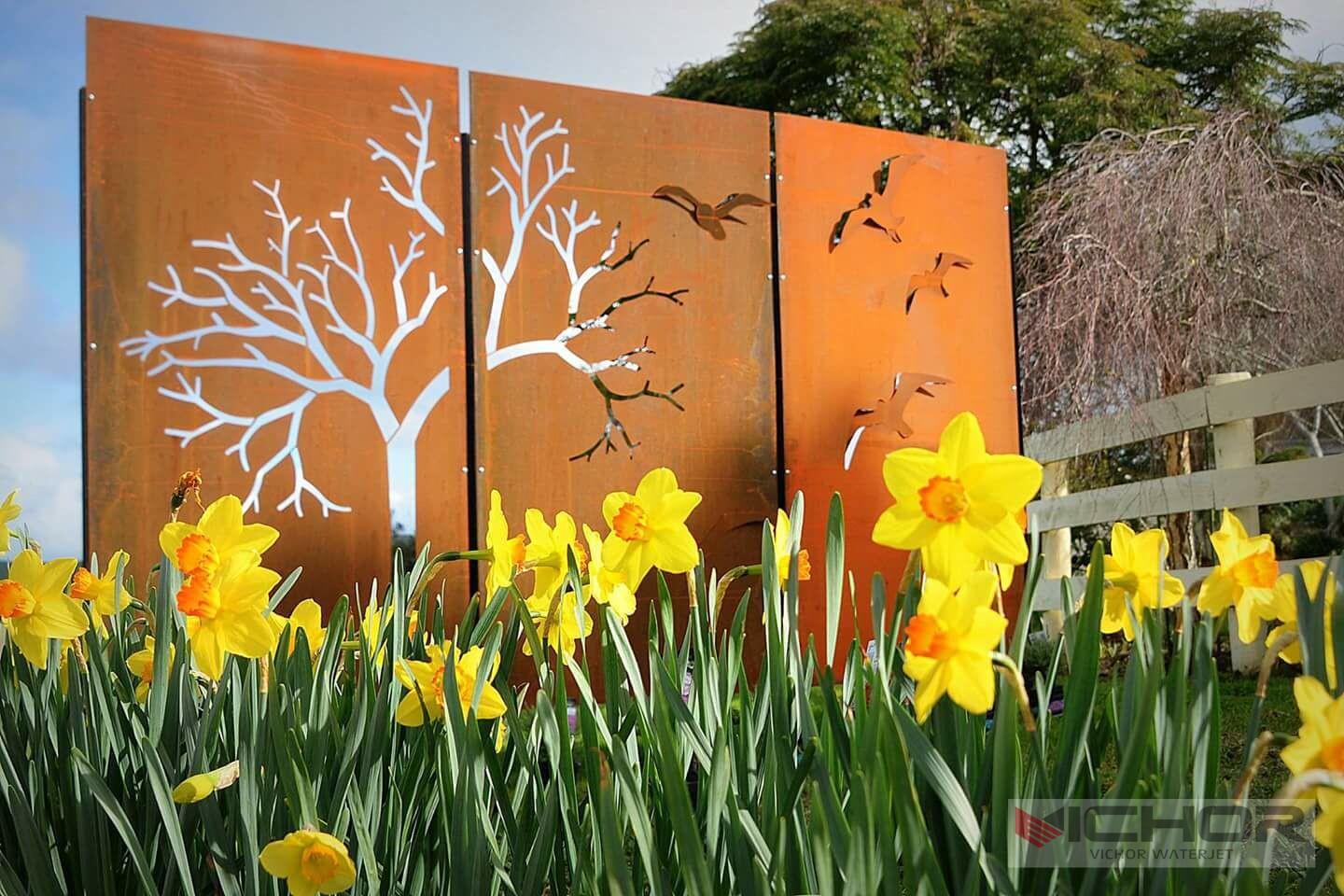
The architectural metal world uses it extensively. Imagine intricate decorative stainless steel facades or complex bronze art installations—cut with perfect detail and no discoloration.
It’s also the go-to for layered or sensitive materials. You can cut stacks of metal sheets, or metal bonded to rubber or composites, in a single pass, something thermal methods cannot do.
Comparing Cutting Methods: Waterjet vs. Laser vs. Plasma
How does high pressure water cutting stack up against its main competitors?
Against Laser Cutting: Lasers are faster on thin, mild steels. But they struggle with reflective metals (like copper, aluminum) and thick plates. The HAZ is a real concern. Waterjet wins on material versatility (any metal), thickness capacity (200mm+), and edge quality without thermal change.
Against Plasma Cutting: Plasma is fast and cost-effective for rough profiling of thick steel. However, it produces a significant HAZ, a beveled edge, and lower precision. Waterjet offers far superior accuracy, a square edge, and no heat input, making it better for parts ready for fabrication.
Against Wire EDM: EDM is incredibly precise but very slow and only conductive. Waterjet provides much faster cutting speeds for most profiles while maintaining excellent tolerances.
Understanding the Costs and Pricing Factors
Many assume high pressure water cutting metal is expensive. It’s more accurate to say its value is often in the total part cost, not just the cutting invoice.
Pricing is usually per linear inch of cut or by machine time. The main cost drivers are:
Material Thickness: This is the biggest factor. Cutting slows down dramatically as thickness increases, consuming more abrasive and time.
Material Type: Harder alloys like tool steel or Inconel cut slower than mild steel, affecting price.
Part Complexity: Intricate shapes with tight corners and curves take longer than straight lines.
Abrasive Consumption: Garnet sand is a major consumable. Efficient pumps and controls help manage this cost.
While the hourly rate may be higher than plasma, the savings come from reduced scrap (excellent nesting), minimal secondary finishing, and often, the ability to cut a finished part in one operation.
Key Technical Aspects: From Pump to Cut Edge
The performance of any high pressure waterjet metal cutting operation hinges on its core technology.
The Pump is the engine. Intensifier pumps, like those engineered by VICHOR, are industry standards for reliability. They use hydraulic pressure to create sustained ultra-high water pressure, crucial for consistent cut quality in thick metals. VICHOR’s pump series, known for robust performance, is a common sight in professional shops.
Motion System and Control: A rigid gantry and accurate CNC drive system are essential to hold tight tolerances (often within ±0.1mm). Advanced systems feature dynamic head control to automatically compensate for taper.
Abrasive Delivery: Consistent, clean, and dry abrasive feed is non-negotiable for a smooth cut. Clogging or moisture here ruins consistency.
Software: Modern software does more than drive the machine. It optimizes cutting paths, nests parts to maximize material yield, and can even adjust speed for cornering to improve edge quality.
Finding a Reliable Service or Machine Supplier
If you’re looking to outsource or buy, here’s what to prioritize.
For a Service Provider: Ask about their machine’s pressure capability (higher is better for thick metal). Inquire about their experience with your specific metal type and required tolerances. A good shop will discuss edge quality expectations and can provide sample cuts.
For a Machine Supplier: Look beyond the initial price. Evaluate pump reliability and serviceability. What is the true positioning accuracy? Is the software intuitive and powerful? Brands like VICHOR set a benchmark with focus on pump durability and global technical support, which is vital for minimizing downtime.
Check their customer base. Do they supply shops doing serious metal fabrication? That’s a strong endorsement.
Frequently Asked Questions (FAQ)
Q1: What is the maximum metal thickness a waterjet can cut?
A1: There isn’t a universal “maximum.” With sufficient pressure and the right speed, industrial abrasive waterjets can cut through metals over 12 inches (300mm) thick. However, for common structural steels, 6-8 inches is a practical thickness for maintaining a reasonable cutting speed and cost. The limit increases with pump pressure.
Q2: Does the water cause the metal to rust?
A2: No. The cutting process is so rapid that exposure time is minimal. The water used is typically very pure, often deionized. Any residual moisture on the cut edge is easily wiped away, and the metal’s inherent corrosion resistance remains intact. The cut itself does not induce rust.
Q3: What kind of edge finish should I expect on the cut metal?
A3: You’ll get a smooth, satin-matte finish with a fine texture from the abrasive grit. The edge is square with a slight natural taper (kerf), which can be minimized with taper-compensation techniques. It is characteristically burr-free and, due to the cold cut, shows no heat discoloration (blueing or yellowing).
Q4: How does cutting speed compare to a laser for thin metal?
A4: For thin sheet metal (under 1/4 inch / 6mm), a modern fiber laser will almost always be faster for simple shapes. However, if the application demands a perfect, heat-free edge or involves reflective metals like copper or aluminum, high pressure water cutting metal is the chosen method despite the speed difference. The trade-off is quality and material integrity over pure speed.
Q5: Is it necessary to treat the wastewater from abrasive waterjet cutting?
A5: Yes, responsible operation requires it. The wastewater contains fine abrasive particles (garnet) and trace amounts of the cut metal. Most systems use a closed-loop settling tank or clarifier system. The water is recycled, and the sludge (spent abrasive and metal fines) is collected for proper disposal. Professional systems are designed to handle this efficiently.