
Cutting by Water Jet: The Cold Process That Slices Metal, Stone, and Glass
In the world of heavy manufacturing, we often associate power with heat. Plasma torches, laser beams, and oxy-fuel systems all rely on thermal energy to separate materials. However, there is a method that defies this convention, offering superior precision without ever raising the temperature of the part.
The process of cutting by water jet has transformed how job shops handle complex materials. By pressurizing water to levels that exceed 60,000 PSI and forcing it through a gemstone orifice, engineers have created a tool that can erode almost anything in its path.
It sounds counterintuitive. How can soft water slice through six inches of solid titanium? The answer lies in velocity and abrasion. When accelerated to supersonic speeds, water becomes a carrier for abrasive particles, turning the stream into a flexible, high-speed grinding wheel.
The Mechanics Behind the Stream
To understand the power of this technology, you have to look at the pump. The pump is the heart of the system, taking ordinary tap water and compressing it. There are two main types of pumps used in the industry: direct drive and intensifier.
Direct drive pumps operate like an engine, using a crankshaft to move plungers. They are highly efficient and great for continuous use. Intensifier pumps, on the other hand, use hydraulic oil to drive a reciprocating plunger, allowing them to reach ultra-high pressures, sometimes exceeding 90,000 PSI.
Once pressurized, the water travels through stainless steel tubing to the cutting head. Here, the magic of cutting by water jet happens. The water passes through a tiny jewel orifice—usually made of sapphire, ruby, or diamond.
This orifice transforms pressure into velocity. The water exits the jewel at speeds up to Mach 3. In a pure water system (used for soft materials like foam or food), this stream does the cutting. For hard materials, the stream enters a mixing chamber where it creates a vacuum.
This vacuum pulls in garnet sand. The sand mixes with the water and accelerates down a mixing tube. By the time it exits the nozzle, the garnet is moving fast enough to erode steel, stone, or glass on a microscopic level.
Why “Cold Cutting” Matters
The single biggest advantage of this method is the lack of heat. When you cut metal with a laser or plasma, you create a Heat Affected Zone (HAZ). This is a band of material along the edge of the cut that has been chemically altered by the intense heat.
HAZ can cause micro-cracking. It can make the edge brittle. If the part needs to be machined later (like tapping a hole), a hardened edge can break your drill bits. It can also cause warping in thin sheets.
Cutting by water jet is a cold process. The friction creates a small amount of heat, but the water stream immediately cools it. The part remains at room temperature. This is vital for aerospace components where the structural integrity of the metal cannot be compromised.
VICHOR: Durability in High Pressure
High-pressure water is destructive. It wears out seals, tubes, and nozzles. Reliability is the primary concern for any shop owner investing in this technology. This is where VICHOR has made its mark.
VICHOR machines are engineered to handle the brutal environment of abrasive waterjet cutting. Their systems are built with rigid gantries that resist the vibration of the cutting head, ensuring that the precision of the cut is maintained over long production runs.
Furthermore, they focus on the longevity of the high-pressure components. By using premium materials for seals and check valves, VICHOR reduces the frequency of maintenance, allowing shops to keep their spindles running and their projects on schedule.
Material Versatility: One Machine, Any Job
A fiber laser is excellent for thin steel, but it cannot cut granite. A router is great for wood, but it can’t handle hardened tool steel. The process of cutting by water jet is truly universal.
Metals: It cuts everything from aluminum and copper to titanium and Inconel. Because there is no heat, it can cut stacked sheets of material without welding them together.
Stone and Tile: This is the standard tool for countertop fabricators. It can cut sink holes and intricate curves in granite and quartz without the risk of cracking that comes with mechanical saws.
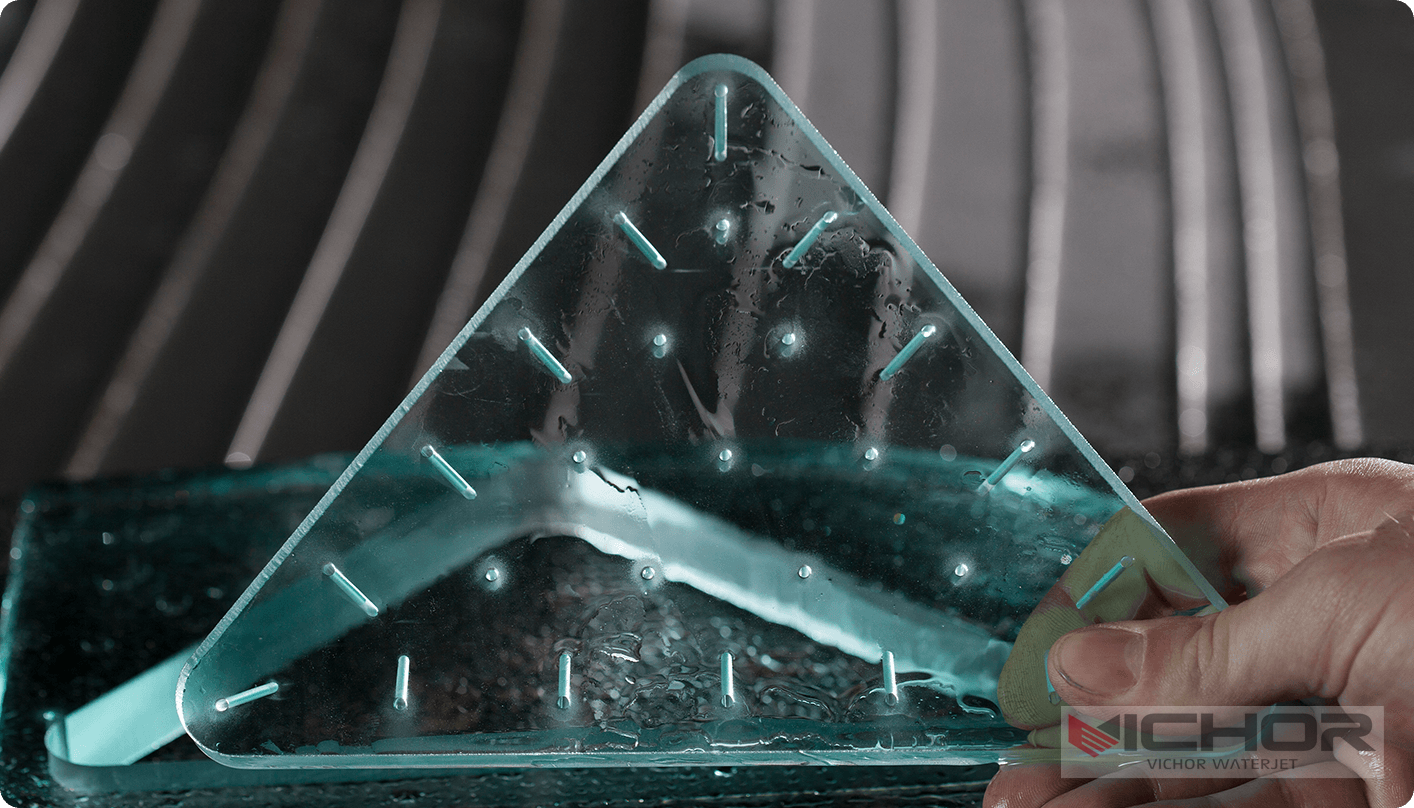
Glass: While glass is brittle, a waterjet can pierce and cut it delicately. By using a low-pressure pierce setting, the machine creates the initial hole without shattering the pane, then ramps up pressure to cut the shape.
Composites: Carbon fiber and fiberglass are notoriously difficult to machine because they delaminate or melt. Waterjets cut them cleanly, leaving a smooth edge that requires minimal finishing.
Abrasive: The Real Cutting Tool
While we call it “water” cutting, the sand does the work. Garnet is the abrasive of choice. It is a hard, inert mineral that is relatively inexpensive. It comes in different mesh sizes.
80 mesh is the industry standard. It offers a good balance of cutting speed and edge finish. 50 mesh is coarser and cuts faster but leaves a rougher edge. 120 mesh is fine and is used for high-precision parts or brittle materials.
The cost of abrasive is a significant factor in the operation. A machine might consume one pound of garnet per minute. Efficient software helps manage this by optimizing cut speeds and reducing waste.
Comparing Waterjet to Laser and Plasma
Choosing the right tool depends on the application. If you are cutting mild steel under half an inch thick and need high volume, a fiber laser is faster and cheaper per part.
However, as the material gets thicker, the laser loses its advantage. Above one inch, laser quality drops and machine cost skyrockets. Plasma is a cheap option for thick plates, but the edge quality is poor, leaving slag (dross) that must be ground off manually.
Cutting by water jet fills the gap. It provides precision comparable to a laser but can handle thicknesses that plasma handles, all with a superior edge finish. If you need a smooth edge on a 4-inch steel plate, waterjet is often the only viable option.
The Issue of Taper
One characteristic of this technology is taper. As the water stream cuts deeper, it loses energy. This can result in a cut that is wider at the top than at the bottom (V-taper). On corners, the bottom of the stream can “lag” behind the top.
Modern machines solve this with 5-axis cutting heads. The software predicts the taper and tilts the nozzle slightly to compensate. This ensures that the edge of the part is perfectly square, even on thick materials.
This capability allows cutting by water jet to be used for precision mating parts that require tight tolerances, eliminating the need for secondary milling.
Environment and Safety
Fabrication shops can be dirty places. Thermal cutting generates smoke, toxic fumes, and dust. Plasma cutting stainless steel releases hexavalent chromium, which is a serious health hazard.
Waterjet cutting is clean. The cutting happens underwater or is immediately captured by the catch tank. There is no dust. There are no fumes. The operator does not need a respirator.
The waste produced is simply water, sand, and metal particles. In most regions, the water can be filtered and sent to the drain, and the sand/metal sludge can be disposed of in a standard landfill. This makes it an environmentally friendly choice.
Cost Considerations
Is it expensive? The hourly rate for running a waterjet is generally higher than plasma but can be competitive with laser. The main costs are garnet abrasive, electricity, water, and wear parts (nozzles and seals).
However, you must look at the “cost per finished part.” Because the process produces a clean edge, you save money on labor. There is no need for grinding, deburring, or secondary machining. A part that comes off the waterjet table is often ready for assembly.
Future Trends in Waterjet Technology
The industry is pushing for higher pressures. “Hyper-pressure” systems running at 90,000 PSI are becoming more common. Higher pressure creates a faster stream, which cuts faster and uses less abrasive.
Automation is also increasing. Robotic arms are being equipped with waterjet nozzles for 3D trimming of automotive interiors and aerospace composites. The flexibility of cutting by water jet makes it ideal for these complex geometries.
Common Questions About the Process
Q1: How thick can you cut with a waterjet?
Q2: Does cutting by water jet cause rust?
Q3: Is waterjet cutting expensive compared to laser?
Q4: Can waterjet cut tempered glass?
Q5: What is the tolerance or accuracy of the cut?