Choosing the Right Garnet for Waterjet Cutting: Quality, Mesh Size, and Performance Factors
For any waterjet operation, abrasive selection is as critical as the machine itself. garnet for waterjet cutting remains the industry standard because of its hardness, angular shape, and availability. The right garnet grade determines cut speed, surface finish, and operating cost per part.
At VICHOR, we engineer waterjet systems that perform best with high‑purity garnet. Matching abrasive properties to your material mix can reduce cutting time by 15–25% while extending mixing tube life. This guide covers everything from mineral composition to recycling strategies.
Why Garnet Dominates Waterjet Abrasives
Several natural and synthetic abrasives exist, yet garnet for waterjet cutting holds a unique position. Its Mohs hardness of 7.5–8.0 provides efficient erosion, while its blocky, angular particles create a consistent cutting stream. Unlike silica sand, garnet is non‑toxic and does not pose respiratory hazards when handled properly.
Mineral Composition and Origin
Most industrial garnet is almandine sourced from alluvial deposits. These deposits yield grains with high specific gravity (4.0–4.2) and low free silica content. Consistency in density ensures predictable jet dynamics.
- Almandine garnet: best balance of hardness and toughness
- Low chloride content: prevents corrosion on stainless steel and aluminum
- Uniform particle shape: reduces nozzle clogging
VICHOR recommends verifying the supplier’s mill test reports to confirm these properties before purchasing any garnet for waterjet cutting in bulk.
Key Quality Parameters That Affect Cutting Results
Not all garnet is equal. Three primary factors dictate performance: hardness, particle shape, and chemical purity. Even small variations can change cut speed by 10% or more.
Hardness and Friability
Hardness ensures the abrasive does not shatter before impacting the workpiece. Friable garnet breaks down too quickly, creating fines that reduce cutting efficiency. High‑quality garnet maintains angularity throughout the cutting process.
Particle Shape and Size Distribution
Angular particles cut faster than rounded ones. A narrow size distribution (e.g., 80 mesh with minimal fines) produces a stable cutting stream. Wide distribution leads to uneven energy transfer and premature nozzle wear.
Chemical Purity
Impurities like quartz, mica, or soluble salts can clog mixing tubes or corrode machine components. Premium garnet for waterjet cutting contains >98% almandine with chloride levels below 50 ppm.
- High quartz content increases nozzle wear
- Excess fines reduce cutting power
- Chlorides accelerate metal corrosion in tank and slats
VICHOR’s engineering team can analyze your garnet sample and recommend adjustments to improve cut efficiency.
Mesh Size Selection: Matching Grit to Material and Thickness
The most common mesh sizes for waterjet are 80, 120, and 200. Each offers a trade‑off between cutting speed and surface finish.
80 Mesh Garnet
This is the industry workhorse. It delivers maximum cutting speed on metals, stone, and composites. Coarser particles transfer more kinetic energy, ideal for thick plates (2 inches and above). Edge roughness is acceptable for most structural applications.
120 Mesh Garnet
A medium grit that balances speed with finer finish. Frequently used for thin metals (under 1 inch), aerospace alloys, and parts requiring reduced secondary finishing. Cuts slightly slower than 80 mesh but yields smoother edges.
200 Mesh and Finer
Used where surface quality is critical – medical instruments, electronics, or pre‑polished stone. Cutting speed drops significantly, but the result often eliminates hand finishing. garnet for waterjet cutting in ultra‑fine grades should be paired with precision nozzles and calibrated mixing tubes.
- 80 mesh: fastest cutting, rougher finish
- 120 mesh: balanced speed/finish, most common
- 200+ mesh: premium finish, slower feed rates
VICHOR waterjet systems include software that lets operators adjust abrasive flow rate based on mesh size, ensuring optimal cutting efficiency regardless of the garnet used.
Economic Impact: Cost vs. Cutting Performance
Garnet accounts for 30–50% of total waterjet operating costs. Selecting the cheapest available abrasive often increases total cost due to slower cutting, more frequent nozzle changes, and increased downtime.
Total Cost of Ownership (TCO) Calculation
When evaluating garnet for waterjet cutting, consider cut speed, mixing tube life, and disposal costs. A garnet that costs 10% more but cuts 15% faster yields net savings. Similarly, low‑purity garnet can shorten mixing tube life by 30% or more.
Bulk Purchasing and Logistics
Buying in 2,000–3,000 lb super sacks reduces per‑pound cost. Proper storage – indoors, away from moisture – prevents clumping and maintains flow consistency. VICHOR offers integrated hopper systems that regulate feed rates to match the abrasive being used.
- Track cost per linear inch of cut, not just per pound
- Consider automated garnet removal to reduce labor
- Use closed‑loop recycling to cut consumable expenses
Many VICHOR waterjet cutting machines include abrasive recovery options that allow shops to reuse garnet multiple times, lowering long‑term abrasive costs.
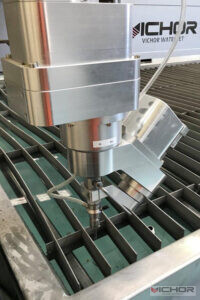
How VICHOR Optimizes Abrasive Performance
Choosing the right waterjet machine is only half the equation. VICHOR provides comprehensive support to maximize the value of your garnet for waterjet cutting investment.
Pre‑Sale Material Testing
VICHOR’s application lab tests your materials with different garnet grades to determine optimal feed rates, pressure, and nozzle size. The result is a validated cutting recipe before you commit to a production setup.
Integrated Abrasive Management Systems
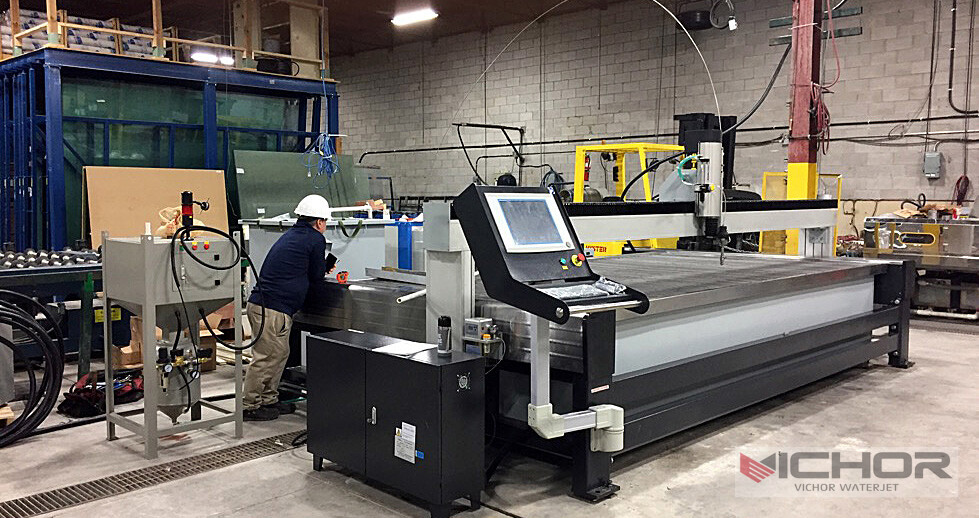
Our waterjet units feature automated garnet delivery that maintains consistent flow regardless of hopper level. Flow sensors alert operators when abrasive is running low, preventing idle time. For shops running multiple shifts, these systems ensure repeatability.
Consumable Life Optimization
Using high‑quality garnet for waterjet cutting in combination with VICHOR’s diamond‑orifice nozzles extends mixing tube life by up to 40%. Our technical bulletins provide recommended pressure‑grit combinations for specific materials.
Sustainable Practices: Recycling and Disposal of Spent Garnet
Waterjet cutting generates significant amounts of used garnet mixed with water and fine cuttings. Responsible disposal or recycling reduces environmental impact and can cut abrasive costs.
Garnet Recycling Systems
Advanced waterjet tables can be equipped with garnet recycling units that separate usable abrasive from fines and metal particles. Recycled garnet, when properly cleaned, maintains about 80–90% of original cutting performance. VICHOR offers modular recycling attachments for all machine sizes.
Disposal Considerations
Spent garnet is generally non‑hazardous, but local regulations may require testing for heavy metals if cutting alloys. Dried garnet sludge can be used as aggregate in construction or sent to approved landfills. VICHOR assists customers in setting up compliant waste management plans.
- Closed‑loop water filtration reduces disposal volume
- Recycled garnet works well for secondary cutting operations
- Proper slurry drying lowers transportation costs
By integrating recycling, shops can reduce new garnet for waterjet cutting consumption by 30–50%, lowering operating expenses while meeting sustainability goals.
Common Myths About Waterjet Garnet
Several misconceptions lead to suboptimal abrasive choices. Clearing these up helps operators achieve better results.
Myth 1: “Any garnet works the same”
False. Garnet from different sources varies in hardness, shape, and purity. Using low‑grade material increases nozzle wear and slows cutting. Always request a certificate of analysis.
Myth 2: “Finer grit always gives a better finish”
While finer grit improves surface smoothness, it also reduces cutting speed significantly. The optimal choice depends on the balance between productivity and finish requirements.
Myth 3: “Recycled garnet is worthless”
Properly processed recycled garnet retains sufficient cutting ability for many applications. It is particularly effective for rough cutting or multi‑pass operations.
Selecting the Optimal Garnet for Your Operations
The choice of garnet for waterjet cutting influences every aspect of your production – from throughput to tool life. By focusing on purity, mesh size, and supplier consistency, manufacturers can achieve faster cutting, lower operating costs, and superior edge quality.
VICHOR’s expertise extends beyond machine building. We provide comprehensive guidance on abrasive selection, recycling strategies, and process optimization. Contact our team to schedule a material test and see how the right garnet transforms your waterjet cutting efficiency.
Frequently Asked Questions About Garnet for Waterjet Cutting
Q1: What is the best mesh size for cutting stainless steel?
A1: For stainless steel up to 1 inch thick, 80 mesh garnet for waterjet cutting delivers the fastest cutting speed. For thinner sheets (under ½ inch) where edge finish matters, 120 mesh provides a smoother surface with moderate speed.
Q2: How do I know if my garnet is high quality?
A2: Request a mill certificate showing Mohs hardness >7.5, almandine content >98%, and chloride <50 ppm. Also check that the particle size distribution is tight (±10% around the nominal mesh). VICHOR can analyze a sample in our lab.
Q3: Can I mix different garnet batches?
A3: Mixing garnet from different suppliers or grades can cause inconsistent cutting results. If you must blend, ensure the hardness and mesh size are nearly identical. It is safer to use one consistent source for production work.
Q4: How should I store bulk garnet?
A4: Store super sacks or bags in a dry indoor area away from humidity. Moisture causes garnet to clump, leading to irregular flow and clogged mixing tubes. Keep pallets elevated to prevent ground moisture absorption.
Q5: Does recycled garnet perform as well as new garnet?
A5: Recycled garnet, after proper cleaning and screening, typically retains 80–90% of the cutting efficiency of fresh garnet. It is ideal for secondary cuts, rough profiling, or materials where edge finish is not critical. VICHOR offers recycling attachments to simplify this process.
Q6: Why does my mixing tube wear out faster with some garnet?
A6: Garnet with high quartz content or excessive fine particles accelerates mixing tube erosion. Also, garnet that is too coarse for the nozzle diameter can cause internal abrasion. Using premium, tightly graded garnet for waterjet cutting extends tube life significantly.
For further technical data or to request a sample analysis, visit the VICHOR abrasive support page. Properly selected garnet for waterjet cutting is one of the simplest ways to boost productivity and reduce operating costs. Let our team help you find the optimal solution for your specific materials and production targets.