

Abrasive Water Jet Cold Cutting: Preserve Material Integrity While Achieving Complex Cuts
Why Abrasive Water Jet Cold Cutting Redefines Precision Manufacturing
The “cold” aspect is not merely a marketing term. Unlike laser, plasma, or oxy-fuel, the waterjet process generates no heat during cutting. The kinetic energy of the abrasive particles does the work through erosion, not melting. Temperatures at the cutting zone remain near ambient, typically below 100°F (38°C).
This characteristic is critical for materials sensitive to thermal stress. Heat-treated alloys, hardened steels, and aerospace composites can be cut without compromising their internal structure. There is no need for post-cut heat treatment or slow cooling procedures.
- No heat-affected zone: Material microstructure remains unchanged.
- No burrs or slag: Clean edges ready for welding or coating.
- No toxic fumes: Safe for operators and the environment.
- No material hardening: Drillable and machinable directly after cutting.
Industries from aerospace to medical device manufacturing rely on this cold-cutting principle to maintain strict quality standards and avoid costly rework.
How Cold Cutting Preserves Material Properties
When conventional thermal processes cut metal, temperatures can exceed the material’s melting point. This creates a recast layer, residual stresses, and potential hydrogen embrittlement. Abrasive water jet cold cutting avoids these issues entirely.
Heat-Sensitive Alloys and Titanium
Titanium is widely used in aerospace and medical implants due to its strength-to-weight ratio and biocompatibility. Laser cutting can introduce oxygen contamination and a brittle alpha case layer. Cold cutting leaves titanium with a clean, unaffected surface that requires no chemical milling or grinding to remove damaged material.
Carbon Fiber and Composites
Composite materials are susceptible to delamination and fiber pull-out when exposed to heat. The cold waterjet process cuts cleanly through multiple plies without fraying or melting the resin matrix. Edge quality is consistent, reducing the need for secondary trimming operations.
Hardened Steels and Tool Steels
Hardened steels (up to 60 HRC) can be cut without softening the edges. This is essential for dies, molds, and wear parts where surface hardness directly affects performance. Parts maintain their specified hardness across the entire cross-section.
Technical Foundations: Achieving Cold Cutting Precision
The system components work together to ensure that the process remains cold while delivering high cutting power. Understanding these elements helps operators maximize performance.
- High-pressure pump: Delivers water at 60,000–90,000 psi, converting pressure into kinetic energy.
- Abrasive metering: Garnet is fed into the cutting head at a controlled rate, providing the erosive force.
- Mixing tube: The water and abrasive combine, accelerating to supersonic speeds.
- CNC motion system: Precisely controls the cutting path, allowing complex shapes and tight tolerances.
Because no heat is generated, the machine’s components also benefit. There is no thermal expansion during long cuts, maintaining positioning accuracy over extended runs.
Applications Where Cold Cutting Is Essential
Certain industries mandate cold cutting processes due to safety regulations or performance requirements. Abrasive water jet cold cutting is often specified for these demanding environments.
Oil & Gas and Marine
Offshore platforms and subsea equipment require materials resistant to corrosion and fatigue. Cold cutting eliminates the risk of micro-cracks that could propagate under cyclic loading. Stainless steel, Inconel, and duplex alloys are processed without altering their corrosion resistance.
Defense and Armor
Ballistic armor plates made from ceramic composites or high-hardness steel must retain their protective properties. Cold cutting ensures that edge treatments do not create weak points or stress risers.
Electronics and Sensitive Components
Thin copper, aluminum, and PCB materials are cut without delamination or thermal warping. The cold process is also safe for components containing batteries or pyrotechnic materials, as no sparks or ignition sources are present.
Efficiency and Cost Benefits of Cold Cutting
While the upfront investment in a waterjet system may be higher than some thermal cutters, the total cost of ownership often proves lower when considering all factors.
- Reduced secondary operations: No deburring, grinding, or heat treatment required.
- Material savings: Narrow kerf (0.02–0.05 in) allows tight nesting.
- One-step process: Complex shapes are cut directly from the material without fixturing for multiple setups.
- Longer tool life: No contact between machine and workpiece means no cutter wear or breakage.
Garnet recycling systems can recover up to 70% of the abrasive, further lowering consumable costs. Additionally, the ability to cut stacked sheets multiplies productivity for thin materials.
VICHOR’s Approach to Cold Cutting Systems
For manufacturers seeking reliable abrasive water jet cold cutting solutions, VICHOR provides machines engineered for precision and durability. Their systems feature high-rigidity steel frames that resist vibration, ensuring consistent cut quality even at high speeds.
VICHOR integrates advanced CNC controls with user-friendly software, allowing operators to program complex geometries and adjust parameters for different materials. The abrasive delivery system is designed for consistent flow, minimizing fluctuations that could affect edge quality.
Service and support are central to VICHOR’s offering. From installation to ongoing maintenance, their team ensures that customers achieve maximum uptime and part quality. For shops looking to expand into cold cutting capabilities, VICHOR provides application testing and process optimization.
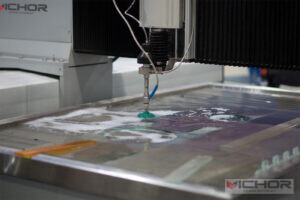
Cold Cutting vs. Traditional Thermal Processes
Choosing the right cutting method depends on material, thickness, and quality requirements. Below is a comparison that highlights where cold cutting excels.
- Laser: Fast on thin metals but creates HAZ, cannot cut reflective materials consistently, and generates fumes.
- Plasma: Economical for thick carbon steel but produces beveled edges, slag, and wide HAZ.
- EDM: Excellent for precise shapes but slow and requires conductive materials; not suitable for non-metals.
- Abrasive water jet cold cutting: Cuts any material, any thickness, with no heat damage, and maintains tight tolerances.
For job shops that process diverse materials, cold cutting offers unmatched flexibility. One machine can handle everything from 0.5 mm titanium foil to 200 mm steel plate.
Maintenance Practices for Consistent Cold Cutting Performance
Proper maintenance ensures that the cold cutting process remains efficient and reliable over years of operation. A few key practices make a significant difference.
- Inspect mixing tubes regularly: Worn nozzles reduce cutting speed and cause edge taper.
- Monitor abrasive quality: Use clean, dry garnet to prevent bridging and inconsistent flow.
- Check high-pressure seals: Prevent pressure loss that reduces cutting power.
- Clean the catcher tank: Accumulated sludge can interfere with water circulation.
VICHOR provides detailed maintenance schedules and genuine replacement parts to keep systems running at peak performance. Their remote monitoring options can alert operators to potential issues before they cause downtime.
Environmental and Safety Advantages
The cold cutting process aligns with modern environmental standards. No hazardous fumes, smoke, or slag are produced. The spent garnet is inert and can often be recycled or disposed of as non-hazardous waste.
Water used in the system is typically recirculated through a closed-loop filtration system, reducing fresh water consumption. Noise levels are mitigated with sound enclosures, and the absence of sparks or open flames improves shop safety.
Frequently Asked Questions
Q1: What exactly does “cold cutting” mean in the context of abrasive waterjet?
A1: Cold cutting refers to the fact that the process generates negligible heat. The cutting action is mechanical erosion, not melting. The workpiece temperature typically stays below 100°F (38°C), so there is no heat-affected zone, no metallurgical change, and no thermal distortion.
Q2: Can abrasive water jet cold cutting handle materials that are sensitive to heat, like Inconel or titanium?
A2: Yes. In fact, these materials are ideal candidates for cold cutting. Titanium and Inconel maintain their original mechanical properties without the risk of embrittlement or surface oxidation that occurs with thermal methods. The process is widely used in aerospace and medical applications for these alloys.
Q3: Is there any thickness limitation for cold cutting?
A3: While practical limits depend on the specific machine and pump pressure, modern systems can cut steel up to 8 inches (200 mm) thick and softer materials even thicker. The cold nature of the process does not limit thickness; rather, pump power and abrasive flow rate determine maximum capability.
Q4: How does cold cutting affect the cost compared to laser or plasma?
A4: Initial equipment cost is higher, but operating costs per part often become competitive when factoring in secondary operations. Cold cutting eliminates deburring, heat treatment, and edge clean-up. Additionally, one machine replaces multiple thermal cutters for diverse materials, reducing overall capital expenditure.
Q5: Does VICHOR provide training for operators new to cold cutting technology?
A5: Yes. VICHOR offers comprehensive training programs covering machine operation, maintenance, and process optimization. Their application engineers work with customers to establish cutting parameters for specific materials, ensuring a smooth transition to cold cutting capabilities.
When production demands zero thermal impact and maximum material versatility, abrasive water jet cold cutting stands as the preferred solution. By preserving material integrity, simplifying workflows, and enabling complex geometries, this technology empowers manufacturers to meet the highest quality standards. With VICHOR as a partner, businesses gain access to reliable equipment, expert support, and a pathway to expand their manufacturing capabilities.
continue reading