7 Key Facts About Water Cutting Steel Plate: Precision Without Heat
Water cutting steel plate uses ultra-high-pressure water mixed with abrasive garnet to erode the material. Unlike plasma or laser, this cold process generates no heat, leaving the steel’s metallurgical properties intact. For fabricators working with high-strength or heat-sensitive alloys, water cutting steel plate offers a reliable, distortion-free alternative.
The Basics of Water Cutting Steel Plate
How Abrasive Waterjet Cuts Through Steel
A waterjet system pressurizes water to 60,000–90,000 psi. At the cutting head, garnet abrasive is fed into the stream. The mixture exits through a small focusing tube at high velocity, eroding the steel along a programmed path.
- No heat affected zone (HAZ) – edges remain soft and machinable.
- Cuts mild steel, stainless, tool steel, and even hardened alloys.
- Thickness capability: from thin gauge up to 200 mm or more.
Key Components for Steel Plate Cutting
- High-pressure intensifier pump (60k or 90k psi).
- Abrasive delivery system with garnet hopper and metering valve.
- Cutting head with mixing chamber and sapphire/diamond nozzle.
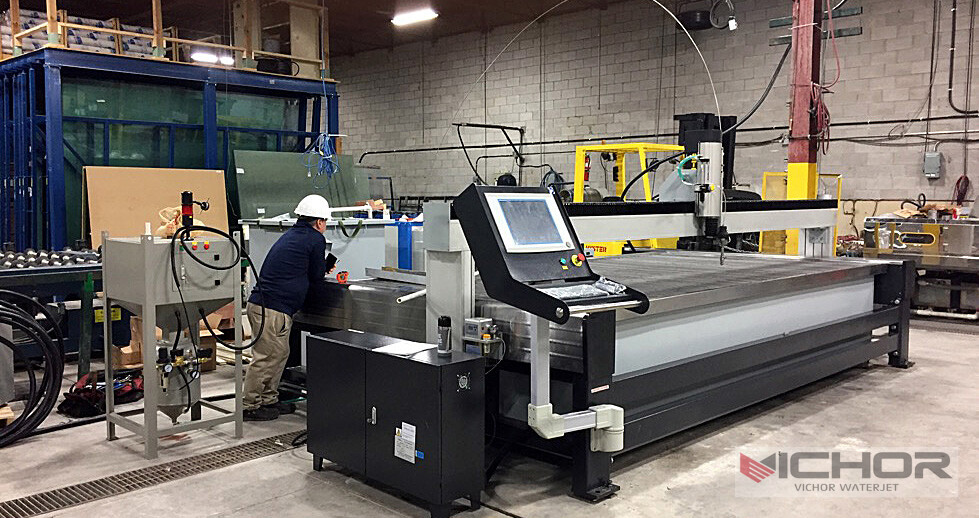
- CNC gantry for precise path control.
- Catch tank with steel grid and water recirculation.
VICHOR manufactures complete systems optimized for water cutting steel plate, with features like dynamic head tilting to reduce taper.
7 Critical Advantages of Water Cutting Steel Plate
Here are the primary reasons fabricators choose water cutting steel plate over thermal methods:
- Cold process: No heat distortion, no micro-cracks, no HAZ – critical for precision welded assemblies.
- Material versatility: One machine cuts mild steel, stainless, tool steel, and clad metals without tool changes.
- Thick plate capability: Easily cuts 100 mm+ steel plate that lasers cannot handle.
- No slag or dross: Edges are clean, often ready for welding or painting.
- No toxic fumes: Environmentally friendly compared to plasma or laser.
- Narrow kerf: Minimal material loss – typical kerf width 1.0–1.5 mm.
- No hard tooling: Ideal for prototypes and short runs.
Steel Types Suitable for Water Cutting
Water cutting steel plate works on virtually all ferrous and non-ferrous metals, but certain steels benefit most:
- Mild steel: Fast cutting, excellent edge quality.
- Stainless steel (304, 316): No heat tint or discoloration, preserving corrosion resistance.
- Tool steel (D2, A2): Cuts hardened material without annealing the edge.
- High-strength low-alloy (HSLA): Maintains mechanical properties.
- Armor plate: Water cutting steel plate avoids work hardening the cut edge.
Water Cutting Steel Plate vs. Laser vs. Plasma
Choosing the right process depends on thickness, volume, and edge requirements. Here’s how water cutting steel plate compares:
- Waterjet: Best for thick plates (20–200 mm), no HAZ, any steel type, but slower on thin sheets.
- Laser: Extremely fast on thin steel (<10 mm), but limited by reflectivity and creates a small HAZ.
- Plasma: Fast on thick steel, but produces a wide HAZ, rough edges, and dross that requires grinding.
For job shops handling diverse steel plate thicknesses, water cutting steel plate offers the widest process envelope.
Optimizing Parameters for Steel Plate
To achieve the best results in water cutting steel plate, operators adjust several variables:
Abrasive Type and Flow Rate
Garnet (80 mesh) is standard. For thicker plates, increasing flow rate (0.5–1.0 kg/min) boosts cutting speed but consumes more abrasive. VICHOR systems include closed-loop abrasive control.
Cutting Speed vs. Edge Quality
Slower speeds produce smoother edges (Ra 3–6 µm). For structural parts where finish is less critical, speeds can be increased, accepting a slightly rougher surface.
Nozzle Selection and Wear
Focusing tubes (0.8–1.5 mm diameter) wear over time. Replacing them regularly maintains accuracy. Carbide and composite nozzles last longer than standard types.
Piercing Techniques
Thick steel requires controlled piercing to avoid damage. Most CNC waterjets use a ramped pressure or slow feed during initial penetration. VICHOR controls automate this sequence.
Common Applications of Water Cutting Steel Plate
Industries rely on water cutting steel plate for parts that cannot tolerate heat or require complex shapes:
- Structural fabrication: Base plates, brackets, gussets for bridges and buildings.
- Heavy equipment: Bucket teeth, wear plates, excavator components.
- Shipbuilding: Hull sections, bulkheads, stiffeners – no distortion after cutting.
- Architectural metalwork: Decorative screens, stair stringers, custom signage.
- Machine building: Gear blanks, motor mounts, machine frames.
Why Water Cutting Steel Plate Deserves a Place in Your Shop
Whether you cut 10 mm mild steel or 150 mm armor plate, water cutting steel plate delivers unmatched quality and flexibility. The cold process eliminates secondary straightening, and the ability to cut any steel alloy without tool changes simplifies scheduling. By investing in reliable equipment from manufacturers like VICHOR, you can expand your capabilities, win more complex jobs, and deliver parts that meet the highest standards. Evaluate your current steel plate cutting needs and see how waterjet technology can improve your throughput and quality.
Frequently Asked Questions About Water Cutting Steel Plate
Q1: How thick of a steel plate can a waterjet cut?
A1: With a 90,000 psi pump and proper abrasive flow, water cutting steel plate can handle up to 200 mm (8 inches) in mild steel and stainless. For thicker plates, cutting speed slows, but quality remains high. Some specialty systems cut up to 300 mm.
Q2: What is the accuracy of water cutting steel plate?
A2: Modern waterjets achieve positional tolerances of ±0.1 mm and cut-path tolerances of ±0.2 mm on steel plate. Taper (angled edge) can be minimized to near zero with dynamic head tilting, available on advanced VICHOR models.
Q3: Does water cutting steel plate cause rust?
A3: The cut edge is wet immediately after cutting, but if left untreated, flash rust can appear on mild steel within hours. Most shops blow dry the parts or apply a light rust preventive. Stainless steel edges remain rust-free.
Q4: What is the cost per part for water cutting steel plate?
A4: Costs include abrasive (garnet), electricity, water, and wear parts. For 25 mm mild steel, typical cost is $0.50–$1.50 per linear meter, depending on speed and abrasive price. The absence of secondary finishing often makes it cost-competitive with plasma.
Q5: Can water cutting steel plate be automated for high-volume production?
A5: Yes, many facilities use automated material handling, stack cutting, and robotic unloading. Waterjets can run lights-out with proper nesting and part ejection. VICHOR offers automation packages tailored to steel fabrication shops.
Q6: What safety precautions are needed for water cutting steel plate?
A6: Operators should wear hearing protection (jet noise exceeds 85 dB) and safety glasses. The high-pressure system requires trained personnel. Proper guarding around the cutting area prevents accidental exposure. VICHOR machines include safety interlocks and remote diagnostics.