7 Key Benefits of Water Jet Cutting Steel Plate for Modern Metal Fabrication
In the world of metal processing, water jet cutting steel plate stands out as a cold-cutting technique that delivers precision without thermal distortion. Unlike plasma or laser, this method uses abrasive-laden water to slice through thick metals, preserving the material’s integrity. VICHOR offers state-of-the-art machinery that harnesses this technology for industries ranging from aerospace to automotive.
1. How Water Jet Cutting Steel Plate Actually Works
The core of water jet cutting steel plate involves pressurizing water up to 90,000 psi. This ultra-high pressure stream is forced through a tiny diamond or sapphire orifice.
At the mixing chamber, garnet abrasive is introduced. The abrasive particles accelerate in the water stream, eroding the steel plate in a controlled line.
The process is entirely computer‑controlled (CNC). This ensures repeatability and complex shapes can be cut with tolerances as tight as ±0.001 inch.
Key components of the cutting head
- Orifice (jewel) – converts pressure into velocity.
- Mixing tube – where abrasive and water combine.
- Focusing nozzle – directs the jet accurately.
2. Top Advantages of Using Water Jet Cutting Steel Plate
Why do fabricators prefer water jet cutting steel plate over traditional methods? The benefits are numerous and often decisive for quality‑driven projects.
- No heat‑affected zone (HAZ): The metal never gets hot, so there is no hardening or micro‑cracking.
- Material versatility: Cuts stainless steel, tool steel, titanium, and even hardened plates up to 150 mm thick.
- Eco‑friendly: No hazardous fumes or gases; only water and garnet, which can be recycled.
- Nesting efficiency: The narrow kerf (0.7‑1.2 mm) allows tight part nesting, reducing scrap.
With VICHOR’s advanced waterjet systems, manufacturers achieve these advantages consistently.
3. Steel Plate Thickness and Quality Capabilities
Water jet cutting steel plate handles thicknesses from 0.5 mm to over 150 mm. The surface finish often eliminates secondary machining.
Typical cutting speeds for mild steel
- 10 mm plate: ~300 mm/min
- 25 mm plate: ~120 mm/min
- 50 mm plate: ~50 mm/min
The edge quality is smooth, with a slight taper that can be minimized by tilting the head or using advanced dynamic control.
4. Industrial Applications That Rely on This Technology
From shipbuilding to food machinery, water jet cutting steel plate is trusted for its versatility.
- Aerospace: Titanium and superalloy structural parts without burrs.
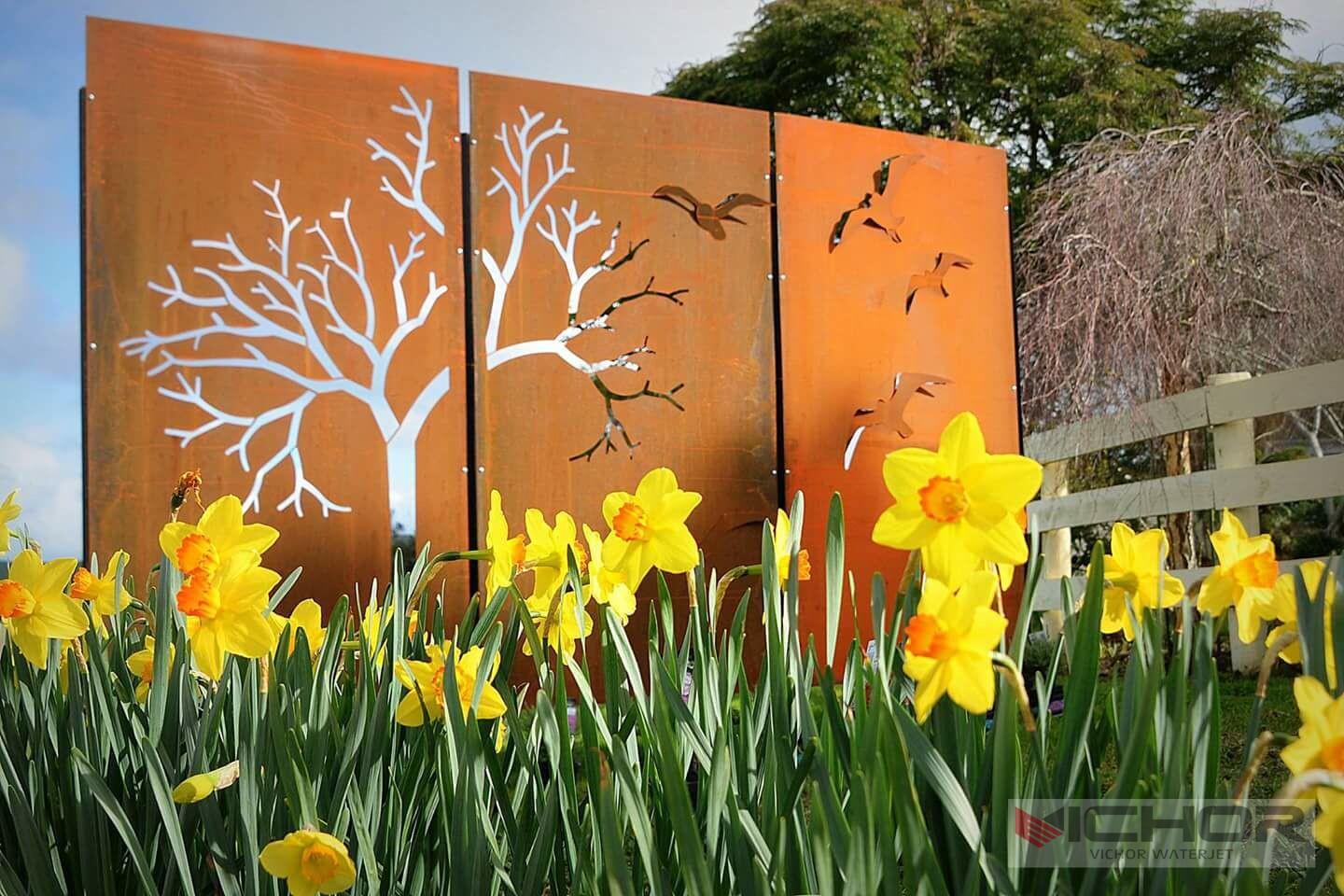
- Architecture: Decorative cladding and stair treads from stainless steel.
- Heavy equipment: Gear blanks and boom components from high‑strength steel.
- Automotive: Prototype brackets and chassis parts.
Many of these industries partner with VICHOR to integrate reliable cutting solutions.
5. Comparing Water Jet to Laser, Plasma, and Oxy‑Fuel
Choosing the right process depends on material and budget. Water jet cutting steel plate offers distinct trade‑offs.
- vs. Laser: Laser is faster on thin sheets (<5 mm) but cannot cut thick or reflective metals reliably. Water jet handles all metals.
- vs. Plasma: Plasma is fast on medium thickness but produces a large HAZ and rough edges. Water jet provides better edge finish.
- vs. Oxy‑fuel: Oxy‑fuel is cheap for carbon steel above 20 mm, but it cannot cut stainless or non‑ferrous. Water jet cuts any alloy.
For mixed‑material shops, water jet is often the most flexible single investment.
6. How VICHOR Waterjet Machines Optimize Production
VICHOR’s water jet cutting machines are engineered for productivity. They feature direct‑drive pumps, high‑pressure rated tubing, and intuitive nesting software.
Operators benefit from automatic abrasive management and camera‑based part alignment. When performing water jet cutting steel plate day after day, reliability matters.
VICHOR machines also integrate easily with robotic loading systems for lights‑out manufacturing.
7. Future Trends in Water Jet Cutting Steel Plate
The industry is moving toward even higher pressures (100k+ psi) and smaller abrasive consumption. Intelligent process monitoring uses sensors to detect worn nozzles and adjust parameters in real time.
Water jet cutting steel plate will also benefit from AI‑assisted path planning, reducing cycle times by up to 20%. VICHOR continues to pioneer these innovations.
Precision and Versatility with Water Jet Cutting
To summarize, water jet cutting steel plate remains a cornerstone of modern fabrication due to its cold‑working nature, material flexibility, and high precision. Whether you need prototypes or mass production, this technology delivers consistent results. Partner with VICHOR to access cutting‑edge water jet equipment tailored to your shop floor.
Frequently Asked Questions (FAQ)
Q1: What thickness of steel plate can water jet cut effectively?
A1: Modern abrasive water jets cut mild steel up to 150 mm thick. For thinner plates (under 25 mm), speeds are very economical. The exact thickness depends on pump power and abrasive flow rate.
Q2: Does water jet cutting steel plate affect its hardness or structure?
A2: No. Because the process generates no heat, there is no heat‑affected zone. The metallurgical properties remain unchanged, which is critical for hardened or heat‑treated steels.
Q3: Is water jet cutting more expensive than laser or plasma?
A3: Operating costs are generally higher due to abrasive consumption and slower speeds on thin material. However, for thick plates or when post‑processing must be minimized, water jet can be more cost‑effective overall.
Q4: Can water jet cut stainless steel without causing rust at the edges?
A4: Yes. Since it is a cold process, there is no oxidation. The cut edge remains corrosion‑resistant, identical to the base material. Sometimes a light rinsing is recommended to remove any abrasive residue.
Q5: What tolerances can I expect when cutting steel plate with water jet?
A5: Standard tolerances are around ±0.1 mm. With dynamic cutting heads and precise calibration, ±0.05 mm is achievable on plates up to 25 mm thick.
Q6: How often should the nozzle be replaced when cutting steel plate?
A6: The mixing tube (nozzle) typically lasts 40‑80 hours of cutting time, depending on abrasive quality and pressure. Regular inspection ensures consistent cut quality. VICHOR supplies durable wear parts for extended life.