
5 Reasons an Industrial Water Jet is Your Shop's Most Versatile Tool
If you walk through any serious fabrication facility, you’ll see the usual suspects: plasma cutters, laser systems, and bandsaws. But the machine that often gets the most interesting work is the industrial water jet. It’s the one they use for jobs the others can’t handle – from slicing through 8-inch titanium to delicately carving intricate patterns in stone.
This isn’t a niche technology anymore. For many shops, an industrial water jet has become the central piece of equipment that streamlines workflow and unlocks new capabilities. Let’s look at what makes this technology indispensable, how it works in a factory setting, and what you should know before integrating one. We’ll also explore how a global leader like VICHOR builds systems for 24/7 production environments.
What Defines an Industrial Water Jet?
An industrial water jet isn’t just a big water cutter. It’s a heavy-duty machine tool engineered for reliability, precision, and continuous operation. Unlike smaller or desktop models, an industrial water jet is built to withstand the demands of a factory floor, running multiple shifts day after day.
The key differentiators are power, size, and durability. These systems feature high-horsepower pumps generating pressures up to 90,000 PSI or more. They have large cutting beds, often custom-sized, to handle full sheets of material. Their frames are massively constructed from steel to resist vibration and maintain accuracy over years of use.
When you invest in an industrial water jet, you’re buying a production asset, not a prototyping tool.
The Core Mechanics of Industrial Waterjet Cutting
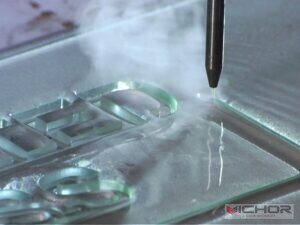
The principle is simple, but the execution is complex. An industrial water jet uses a ultra-high-pressure pump to force water through a tiny orifice, creating a supersonic stream.
For cutting metals, stone, ceramics, and composites, a hard abrasive (usually garnet) is introduced into the stream. The water acts as the carrier, accelerating the abrasive particles to speeds over twice the speed of sound.
These particles do the actual cutting through micro-erosion. The stream effectively removes material particle by particle along a computer-controlled path. This CNC-guided process ensures every part is identical to the digital design.
The result is a cold-cutting process that leaves the material’s structure completely unchanged.
Key Industries That Run on Industrial Water Jets
Aerospace manufacturing relies heavily on industrial water jet technology. It’s used for cutting titanium engine components, aluminum airframe parts, and advanced composites without creating a heat-affected zone that could compromise material integrity.
The heavy equipment and mining sector uses these machines to cut thick steel plate, hardened alloys, and abrasive-resistant liners. The ability to process materials over 6 inches thick is a standard requirement here.
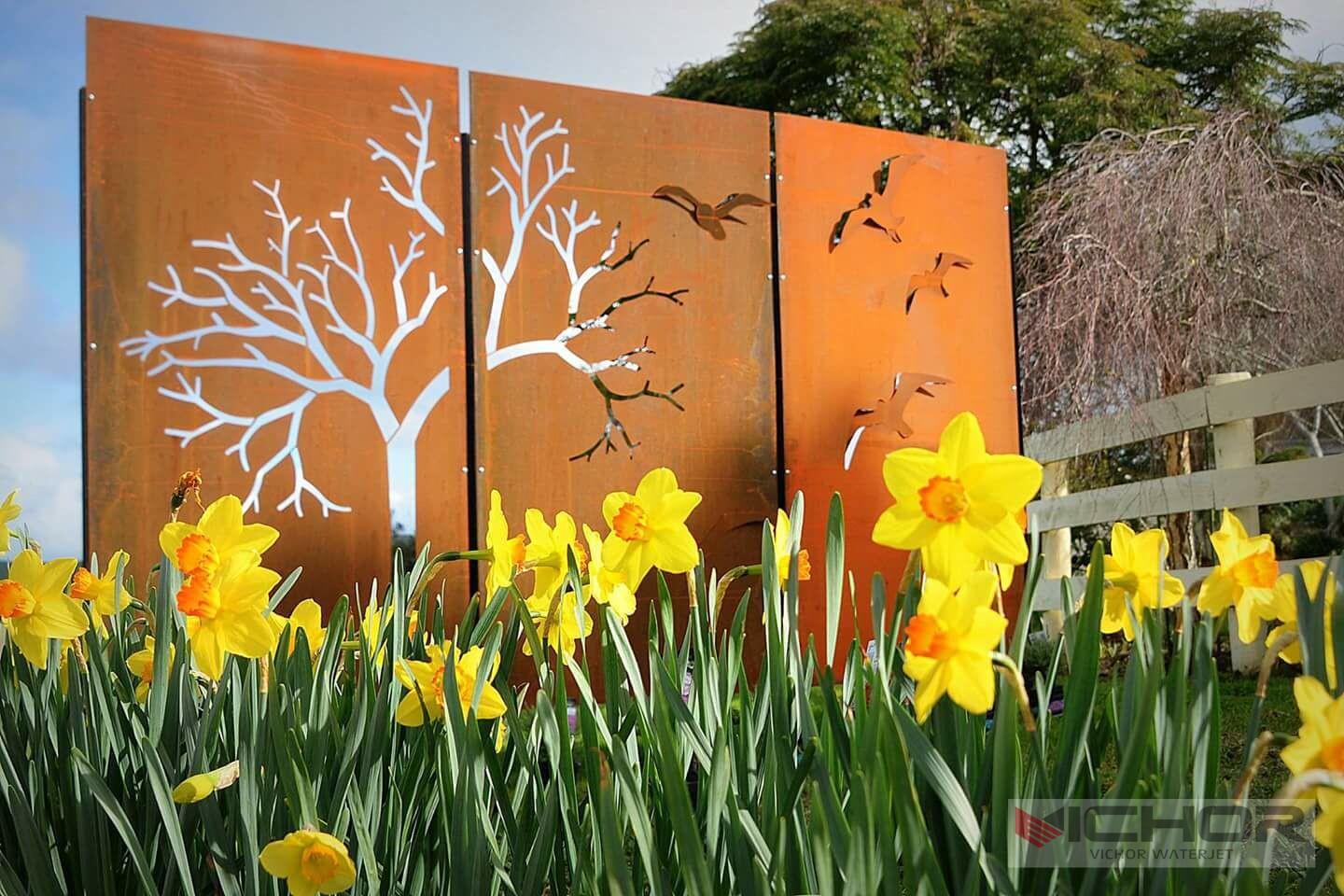
In architecture and construction, an industrial water jet creates intricate stone and tile inlays, detailed metal façades, and custom countertops. The precision allows for breathtaking designs that would be impossible with traditional stone-cutting tools.
The automotive industry uses them for everything from prototyping new designs to cutting interior components and custom gaskets. The flexibility to switch materials without changing tools is a major efficiency boost.
The Tangible Benefits for Your Production Line
The most significant advantage is the cold-cutting nature of an industrial water jet. There is zero heat input into the material. This means no thermal distortion, no hardened edges, and no change to the material’s mechanical properties.
This alone eliminates costly secondary operations like stress-relief heat treatment or machining to remove heat-affected zones. Parts often come off the table ready for use.
Versatility is another massive benefit. A single industrial water jet can process over 500 different materials. You can cut rubber gaskets, aluminum brackets, and granite tiles on the same machine, in the same job if needed. This flexibility can consolidate multiple dedicated machines into one.
The precision is exceptional. Modern systems can hold tolerances within ±0.003 inches. This accuracy, combined with advanced nesting software, dramatically reduces material waste, providing significant savings on expensive metals and composites.
Types of Industrial Water Jet Systems
The two main categories are pure waterjet and abrasive waterjet. Pure waterjet systems are used for soft materials like foam, rubber, and food products. For most industrial applications, an abrasive waterjet system is the standard.
Pump technology is a key differentiator. Intensifier pumps are the most common in industrial settings, known for their reliability and ability to generate consistent ultra-high pressure. Direct drive pumps offer a different approach, often with a smaller footprint.
Table configurations vary widely. Standard gantry systems are the workhorses. Some applications benefit from 5-axis cutting heads that allow for bevel cutting and complex 3D shapes. For the highest volume production, multi-head systems are available that cut multiple identical parts simultaneously.
Cost Analysis and Return on Investment
An industrial water jet represents a significant capital investment. However, the total cost of ownership and ROI often tell a compelling story.
The reduction in material waste through efficient nesting can pay for the machine over time. This is especially true when working with high-value materials like titanium, stainless steel, or composite panels.
Consider the elimination of secondary processing. When parts don’t require deburring, grinding, or heat treatment, you save on labor, equipment, and time. The production cycle shortens considerably.
Operating costs are primarily electricity, water, abrasive garnet, and wear parts. A reliable brand like VICHOR designs its industrial water jet systems for low life-cycle costs and maximum uptime, protecting your profitability.
VICHOR’s Approach to Industrial-Grade Solutions
VICHOR has built its reputation on manufacturing industrial water jet systems that can withstand the toughest environments. Their machines are engineered not just for precision, but for durability and ease of maintenance.
They offer a range of solutions, from standard platforms to fully customized cutting cells integrated with robotics and material handling systems. VICHOR’s application engineers help clients select the right pump, table size, and software for their specific production needs.
Beyond the hardware, VICHOR provides comprehensive support. This includes operator training, preventative maintenance plans, and a global network of service technicians. This ensures that your production asset remains productive year after year.
For many businesses, starting with VICHOR’s contract cutting service is a smart way to validate the technology and its impact on their workflow before making a capital investment.
Is an Industrial Water Jet the Right Fit for Your Shop?
Integrating an industrial water jet is a strategic decision. It’s ideal for operations that work with a variety of materials, require high precision, and want to reduce their overall manufacturing timeline and cost.
If your work consists entirely of straight-line cuts on mild steel, a plasma table might be more economical. But for complexity, material diversity, and flawless edge quality, the industrial water jet is unmatched.
The next step is often a material test. Providing a sample of your most challenging material to a company like VICHOR will give you real-world data on cut speed, edge quality, and accuracy. This concrete information is invaluable for making a sound investment decision.
Frequently Asked Questions
Q1: How does an industrial water jet compare to laser cutting for metal?
A1: Lasers are faster on thin sheet metal but generate a heat-affected zone. An industrial water jet is a cold process, making it superior for thicker materials (over 1/2 inch), heat-sensitive metals, and composites where heat would cause damage.
Q2: What is the maximum thickness an industrial water jet can cut?
A2: It is common for industrial systems to cut metals over 6 inches thick and materials like concrete and armor plate up to 12 inches or more. The practical limit depends on the pump pressure and the material’s hardness.
Q3: How loud is an industrial water jet during operation?
A3: The pump is the primary noise source, often requiring hearing protection in the immediate area. The cutting process itself, enclosed in a tank, is relatively quiet. Modern systems often feature sound-dampening enclosures for the pump.
Q4: What are the main maintenance requirements?
A4: Regular maintenance includes checking and replacing high-pressure seals, cleaning the abrasive delivery system, and changing worn nozzles and mixing tubes. A disciplined maintenance schedule is key to preventing unplanned downtime.
Q5: Is the cutting stream dangerous to operators?
A5: The stream is incredibly powerful and can cause serious injury. However, all reputable industrial water jet systems are fully enclosed with interlocked safety doors that stop the pump if opened. When proper procedures are followed, the technology is very safe.