5 Realities of Building a Homemade Waterjet Cutter: Safety, Cost & Practicality
The idea is captivating. Videos show high-pressure streams slicing through metal like butter. For a dedicated maker or small shop owner, the thought arises: “Could I build one myself?” Searching for information on a homemade waterjet leads down a rabbit hole of forum posts, sketchy diagrams, and intense debates. The concept seems straightforward – pump water really fast and point it at something. The reality, however, is a complex web of engineering, severe safety hazards, and hidden costs that often outweigh the benefits. Before you source a pump or sketch a frame, it’s crucial to understand what you’re truly getting into. This isn’t a weekend Arduino project.
The Extreme Danger: More Than Just High Pressure
This cannot be overstated. A functional homemade waterjet operates in a realm of extreme danger. We are talking about water pressures at a minimum of 30,000 PSI to cut anything harder than foam.
At these pressures, water is no longer a benign liquid. A pinhole leak can release a stream capable of instantly piercing skin, bone, and metal. It is invisible and inaudible until it hits something.
The stored energy in a pressurized line is immense. A fitting failure could turn a metal component into a high-velocity projectile. There is no “safe” test with a garden hose first. The system either works at lethal pressures or it doesn’t work at all.
Beyond the water itself, an abrasive homemade waterjet adds garnet dust to the air and creates slurry waste. Inhaling fine abrasive particulate is a serious health risk. The operational environment becomes hazardous.
Building one requires a mindset of bomb disposal, not casual tinkering. One design flaw, one substandard fitting, one moment of complacency can lead to life-altering injury.
The Heart of the Problem: Sourcing a Viable Pump
This is the first major wall every DIY project hits. The pump is everything. Common pressure washers max out around 4,000 PSI—an order of magnitude too low for cutting.
You need an intensifier or a direct-drive plunger pump capable of sustained pressure above 40,000 PSI. These are specialized, expensive industrial components. Looking for a used one is a gamble on its remaining life.
The pump also needs a capable power source (often high-voltage three-phase), a precision water filtration system to prevent internal damage, and a cooling system. It is not a single item but a sub-system.
Many homemade waterjet attempts try to modify existing pumps. This almost universally fails. The seals, valves, and cylinders in standard pumps are not rated for ultra-high pressure. They will fail, often catastrophically.
The cost of a new, small industrial pump from a reputable manufacturer can approach the price of an entry-level complete machine from a brand like VICHOR. This fact alone redirects most pragmatic builders.
The Precision Challenge: It’s Not Just a Hose
Assuming you solve the pressure problem, next is control. A cutting head must hold a jewel orifice (sapphire or ruby) that costs $50-$100 each and can shatter if misaligned.
The abrasive must be introduced into the stream in a mixing chamber in a consistent, dry flow. This requires a perfectly synchronized abrasive feed system. Humidity clogs it.
The cutting head must then be mounted on a motion system that can move it with extreme accuracy while resisting the immense force of the water jet pushing back. A flimsy CNC router frame will shake violently.
Your homemade waterjet will need software to convert CAD designs into machine paths (G-code) and a controller to drive the motors. Creating a consistent, reliable cut requires syncing this motion with the pump pressure and abrasive feed.
This is the realm of precision mechanical and electrical engineering. Getting a drip-free, steady stream at 50,000 PSI that follows a path within a hair’s width is the culmination of decades of industrial design.
The True Cost: Time, Money, and Frustration
Let’s talk numbers. The romantic idea of a homemade waterjet is saving money. The spreadsheet tells a different story.
A used or low-end industrial pump: $10,000 – $25,000. High-pressure tubing and fittings (each fitting can be $100+): $2,000. Linear motion components, motors, drives: $5,000. Control software and CNC controller: $3,000. Cutting head, abrasive system, tank, filtration: $4,000.
You quickly surpass $25,000 in parts alone, not counting your own labor measured in hundreds of hours. This is also assuming no costly mistakes, failed parts, or shipping delays.
Now, consider the value of your time. Hundreds of hours spent designing, sourcing, assembling, and (most likely) troubleshooting. This is time not spent on profitable work or actual projects.
For a comparable investment, you could find a used, proven industrial machine or a new entry-level system from an OEM. This leads to the critical comparison.
Homemade vs. Professional: The VICHOR Benchmark
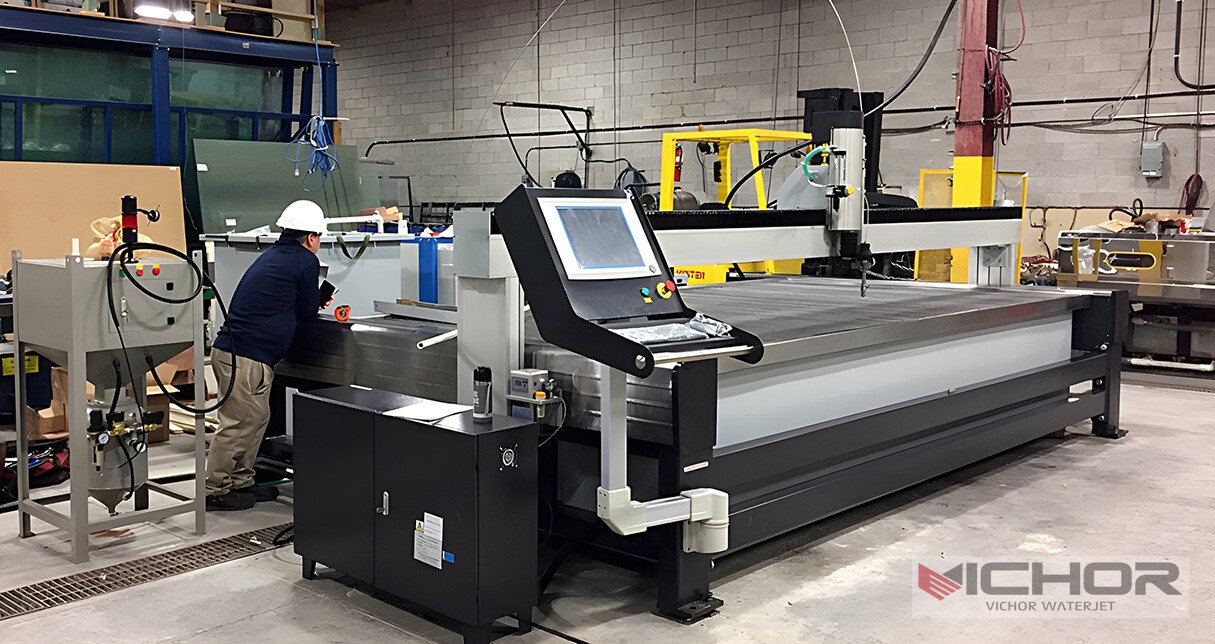
Contrast the homemade waterjet project with a purpose-built machine from an international manufacturer like VICHOR. VICHOR designs compact, entry-level waterjets for small shops.
Their machines start with a pump engineered for reliability and safety, with built-in safeguards and fault detection. The frame is designed from the ground up to be rigid, absorbing the cutting forces without vibration.
The software is integrated and tested, offering features like automatic kerf compensation and nesting. The system comes as a complete, warranted package.
Most importantly, it comes with technical support and safety certifications. When something needs service, you have a manual and a phone number. When you need a spare part, it has a part number.
The total cost of ownership of a homemade waterjet—when factoring in downtime, part failures, and safety risks—often exceeds the price of a scaled, professional solution designed for real-world use. For a business, reliability is revenue.
The One Viable Niche: Very Low Pressure Cutting
There is a sliver of the DIY realm that is feasible. Some builders create “waterjets” for cutting very soft materials like foam, rubber, or thin plastics.
These systems use modified pressure washers or pumps in the 1,000-10,000 PSI range. They are pure water, no abrasive. The safety risks are lower, though still present.
They can be built for specialized tasks like custom packaging inserts or hobbyist model making. This is a far cry from cutting metal or stone, but it legitimately fits the homemade waterjet label for a specific, limited purpose.
If your goal is to cut insulation foam for terrain modeling, this path has merit. If your goal is to cut titanium, steel, or glass, this approach is utterly irrelevant.
A More Practical Path: Collaboration or Purchase
For most people lured by the idea, there are better options. Consider finding a local makerspace or workshop that already has a professional waterjet. Pay for access or membership.
This gives you hands-on experience with a real machine, safely. You learn the software and the process’s capabilities and limitations without any capital risk.
For a business, conduct a serious ROI analysis. Calculate your current outsourcing costs. You may find that financing a small, new machine like a VICHOR compact model pays for itself in under two years, all while adding a new revenue stream.
The journey from a homemade waterjet dream to a functional, safe, and accurate cutter is so arduous that it transforms from a money-saving project into an all-consuming, expensive engineering thesis with inherent danger.
The pursuit of a homemade waterjet is often born from ingenuity and a desire to conquer a technical challenge. However, the stark realities of hyper-lethal pressure, precision engineering, and staggering hidden costs make it a questionable endeavor for all but the most expert and safety-obsessed engineers. For the vast majority of makers, artists, and small business owners, the smarter, safer, and ultimately more economical path lies in accessing professional equipment or investing in a scaled, reliable OEM machine from a trusted brand like VICHOR. The true achievement isn’t in building the tool, but in efficiently creating what you envisioned with the right tool for the job.
Frequently Asked Questions (FAQs)
Q1: What is the absolute minimum pressure needed for a homemade waterjet to cut metal?
A1: To cut even thin sheet metal (like 1/8″ aluminum or mild steel) with abrasive, you need a sustained, focused pressure of at least 40,000 PSI. Pure water cutting of metal is not feasible at any DIY-attainable pressure; abrasive is mandatory, which multiplies the system’s complexity.
Q2: Can I use a converted pressure washer for a homemade waterjet?
A2: For cutting metal, stone, or glass, no. Commercial pressure washers operate far too low (typically under 4,000 PSI) and lack the continuous flow and pressure stability required. They may work for cutting very soft materials like foam or cardboard, but this is a fundamentally different tool.
Q3: What is the most dangerous component of a homemade waterjet?
A3: The entire high-pressure system is dangerous, but the most unpredictable risk points are the connections (fittings and hoses) and the pump itself. A failure here can release an invisible, supersonic jet of water or cause explosive decompression of metal components.
Q4: How much would it realistically cost to build a homemade waterjet that can cut 1/2-inch steel?
A4: Realistically, sourcing all new, reliable components to safely and consistently cut 1/2-inch steel would likely cost between $30,000 and $50,000 in parts alone. This assumes you have the advanced engineering skills to design and integrate them. It is rarely cheaper than a commercial entry-level machine.
Q5: Are there any reputable kits or plans for a safe homemade waterjet?
A5: No reputable industrial manufacturer sells DIY kits due to massive liability and safety concerns. Plans found online are often theoretical, incomplete, and come with no safety validation or support. Following them is done at your own extreme personal and financial risk.