
4 Features That Define a True Granite Water Cutting Machine
For stone fabricators, the leap from traditional saws and polishers to a granite water cutting machine is a transformative decision. This technology, more formally known as an abrasive waterjet system, uses a high-pressure stream of water and garnet to slice through granite with cool precision. But not every waterjet is built for the demanding environment of a stone shop. Cutting granite slabs day in and day out requires a specific kind of robustness and power. Understanding the key features that separate a standard machine from a true industrial granite water cutting machine is critical for making a smart investment that boosts your capabilities and bottom line.
Core Concept: More Than Just a Pump and a Table
At its heart, every granite water cutting machine operates on the same principle. An ultra-high-pressure pump, typically an intensifier type, pressurizes water to between 60,000 and 90,000 PSI.
This water is forced through a tiny gemstone orifice, creating a supersonic jet. In a mixing chamber, hard abrasive garnet is introduced into this stream. The accelerated abrasive particles do the actual cutting, eroding the granite through micro-machining.
What defines a machine built for granite is how it sustains this process under heavy, daily load. It’s about structural integrity, power reserves, and systems designed to handle the weight and abrasiveness of stone. A machine that excels at cutting thin metal may struggle and wear prematurely in a granite shop.
Key Feature 1: A High-Powered, Industrial Pump
The pump is the engine. For granite, you need ample and consistent power. A pump under 50 horsepower (HP) will likely be underpowered for cutting 2cm or 3cm slabs at productive speeds, especially on harder stone varieties.
A true granite water cutting machine often features a pump in the 50HP to 100HP range. This provides the necessary pressure and flow rate to maintain cutting efficiency through thick materials. Consistency is also key.
The pump must deliver stable pressure without significant fluctuation. A pressure surge can affect cut quality, while a drop will slow the cut. Industrial-grade pumps from manufacturers like VICHOR are engineered for this kind of continuous, demanding operation.
Key Feature 2: A Heavy-Duty, Vibration-Resistant Structure
Granite slabs are incredibly heavy. A machine table and gantry must be engineered to support this weight without flexing or vibrating. A flimsy structure will shake during cutting, leading to wavy edges, reduced accuracy, and accelerated wear on moving parts.
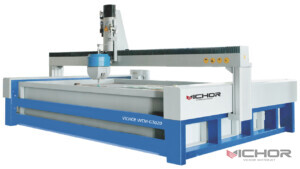
Look for a machine with a robust, welded steel frame. The gantry should travel on heavy, precision-ground rails or similar high-rigidity guides. The driving systems (servo motors, gearboxes) must be sized to move the heavy cutting head and any slab weight smoothly.
This inherent stability is what allows a granite water cutting machine to produce clean, precise cuts on expensive stone, job after job. It’s a fundamental design difference from lighter-duty systems.
Key Feature 3: Effective Water and Abrasive Management
Cutting granite produces a significant amount of heavy slurry—a mix of water, spent garnet, and granite dust. How a machine handles this waste is a major differentiator.
The cutting tank must be large, strong, and designed for easy cleaning. More importantly, the slurry removal system is critical. Many industrial machines integrate a pump or ejector system to automatically remove slurry from the tank, keeping the water level clean for better cutting visibility and reduced component wear.
The abrasive delivery system must also be reliable and sealed against the fine stone dust prevalent in a shop. A machine designed as a granite water cutting machine will have these material-handling features built-in, not added as an afterthought.
Key Feature 4: Intelligent, Stone-Specific Software
The control software is the brain. For granite, it needs to do more than just move the cutting head. Advanced software includes features like automatic nesting to maximize yield from a costly slab.
It should have a comprehensive material library with pre-set cutting parameters for different granite types (e.g., soft black granite vs. hard white granite). This allows operators to achieve optimal cut speed and quality quickly.
Taper compensation functions are also valuable, helping to manage the natural kerf angle. Software that can seamlessly import DXF files from popular CAD programs streamlines the workflow from design to finished part.
Comparing to Other Stone Cutting Methods
The granite water cutting machine offers unique advantages. Compared to a bridge saw, it provides limitless shape complexity—curves, angles, and intricate cutouts are no problem. It also creates less airborne dust.
Versus a CNC router, it produces no thermal stress, eliminates diamond tooling costs, and can cut much thicker material. The primary trade-off is speed on simple, straight cuts, where a bridge saw is faster.
Therefore, the ideal shop setup often pairs a bridge saw for straight-line work with a granite water cutting machine for complex pieces, sink cutouts, and detailed inlays, maximizing flexibility and capability.
Cost Considerations and ROI for Fabricators
An industrial granite water cutting machine is a significant capital investment. Prices vary widely based on pump power, table size, and brand, but it represents a major purchase.
The return on investment (ROI) comes from several areas. It enables you to bid on and win high-value projects featuring complex designs that competitors cannot easily replicate. It dramatically reduces material waste through optimal nesting.
It consolidates multiple steps (cutting, sink hole drilling, faucet drilling) into one setup, saving labor and handling time. For many shops, the machine pays for itself by attracting new business and improving operational efficiency on existing work.
Choosing a Manufacturer and Service Provider
Selecting the right brand is crucial. Look for a manufacturer with proven experience in the stone industry. Ask for references from other granite fabricators.
Evaluate the local service and support network. When a machine is down, your production stops. A manufacturer like VICHOR, with a global support footprint, can provide faster response times and guaranteed access to genuine parts.
Before purchasing, demand a material test. Bring a sample of your typical granite and have them cut a complex shape. Evaluate the edge quality, speed, and overall performance firsthand.
A true granite water cutting machine is a cornerstone of a modern, competitive stone shop. It’s not merely a cutter; it’s a capability expander. By focusing on the four key features of power, structure, waste management, and software, fabricators can choose a system that delivers reliability and opens new creative and commercial doors. Partnering with an established technology provider like VICHOR ensures this investment is supported for the long term, securing your place at the forefront of stone fabrication.
Frequently Asked Questions (FAQ)
Q1: What is the main difference between a general-purpose waterjet and a granite water cutting machine?
A1: The main differences are power, durability, and specialized features. A granite water cutting machine has a more powerful pump (often 50HP+) to handle thick stone efficiently, a much heavier and more rigid frame to support slab weight without vibration, and robust slurry management systems to handle the high volume of abrasive granite waste.
Q2: How thick of granite can these machines cut?
A2: A well-equipped industrial granite water cutting machine can cut material over 4 inches (100mm) thick. For standard countertop slabs (2cm or 3cm), they work with ease. Cutting speed decreases with thickness, and advanced models may use taper compensation to ensure edge squareness on deeper cuts.
Q3: Can it cut other stones besides granite?
A3: Absolutely. A granite water cutting machine is excellent for all natural and engineered stone. This includes marble, quartzite, travertine, limestone, and engineered quartz like Caesarstone. The cold-cutting process is ideal for preventing cracks or thermal damage in any brittle stone material.
Q4: Is the edge it produces ready for polishing?
A4: The edge straight from the machine has a consistent, honed-like matte finish. It is perfectly uniform and provides an excellent base for polishing. A standard polishing sequence with resin-bonded diamond pads will quickly bring it to a high gloss. It eliminates the unevenness that can come from saw blades.
Q5: Why is a brand like VICHOR recommended for granite cutting?
A5: VICHOR designs its systems for industrial endurance. Their pumps are built for the continuous high-pressure demand of stone, and their machine frames are engineered for the heavy, stable movement required for precision slab work. This focus on core durability, backed by global service, minimizes downtime—a critical factor for production-focused stone shops. Their technology is built to be a true granite water cutting machine.